Why Most Place Bet Advice Ignores the Numbers That Matter
 Available in US
- Why Most Place Bet Advice Ignores the Numbers That Matter
- Field Size as a Strategic Filter: Quick Decision Framework
- Going Ground: How to Read It Before You Bet
- Favourites in Place Markets: When Odds-On Horses Still Pay
- Identifying Value: Place Odds That Exceed True Probability
- Staking Methods for Place Betting: Level, Proportional and Target
- Bankroll Management: Protecting Capital Across a Place Betting Campaign
- FAQ
Why Most Place Bet Advice Ignores the Numbers That Matter
Open any betting guide to the section on place bets and you will read the same thing: “Place betting is great for beginners because it is lower risk.” That is like saying driving is great for beginners because the car has brakes. It is technically true and practically useless. Lower risk does not mean profitable, and the gap between the two is filled with data that almost nobody in the place betting space bothers to present.
I have spent nine years tracking place bet outcomes across UK Flat and National Hunt racing, and the single biggest predictor of long-term profitability is not the horse you pick or the odds you take. It is the structural filters you apply before you even open a racecard. Field size. Going ground. Race type. Place terms. These are the variables that determine whether a place betting approach has a positive expected value over hundreds of bets or a slow, steady drain on your bankroll.
Average field sizes in 2025 ran at 8.90 for Flat and 7.84 for National Hunt — numbers that set the baseline for how many places are paid and at what fraction. Favourites won roughly 33% of races in large fields but over 80% in small ones, with strike rates on good going exceeding 50% and dropping to around 20% on heavy ground. Those are not trivia. They are the load-bearing numbers of any place bet strategy, and ignoring them is the reason most recreational place bettors lose money slowly enough that they never notice.
This guide lays out a quantitative framework for place betting — not tips, not hunches, not “back the favourite to place and hope.” Each section covers a specific variable, the data behind it and the practical decision it should inform. The goal is a repeatable process that you can apply to any race, any day, at any track in Britain.
See also: place bet horse racing for strategy guides across all race types.
Field Size as a Strategic Filter: Quick Decision Framework
A mate of mine spent an entire Flat season backing horses to place in five-runner fields. He picked well — his selections finished in the first three about 60% of the time. He still lost money. The problem was not his form reading. The problem was that five-runner races pay only two places at 1/4 the odds, which means the payout on a place finish barely exceeds your stake unless the horse is a long shot. He was winning bets and losing a bankroll because he never looked at the structural maths before he started.
Field size is the single most important pre-filter in place betting because it determines two things simultaneously: how many places are paid and at what fraction of the win odds. A race with eight or more runners pays three places at 1/4 the odds. A handicap with 16 or more runners pays four places at 1/5 the odds. Those two thresholds — eight runners and 16 runners — are the dividing lines between place betting that has structural edge potential and place betting that is essentially a coin flip with poor returns.
Here is a quick framework I use. For races with four or fewer runners, I skip the place market entirely. Only one place is paid — the winner — which means a place bet is identical to a win bet. For five to seven runners, I get selective — the race needs a clear form standout who is priced between 3/1 and 8/1 before the place fraction makes it worth the stake. Most open Flat races naturally land in the eight-plus bracket where three places at 1/4 odds create a more workable margin.
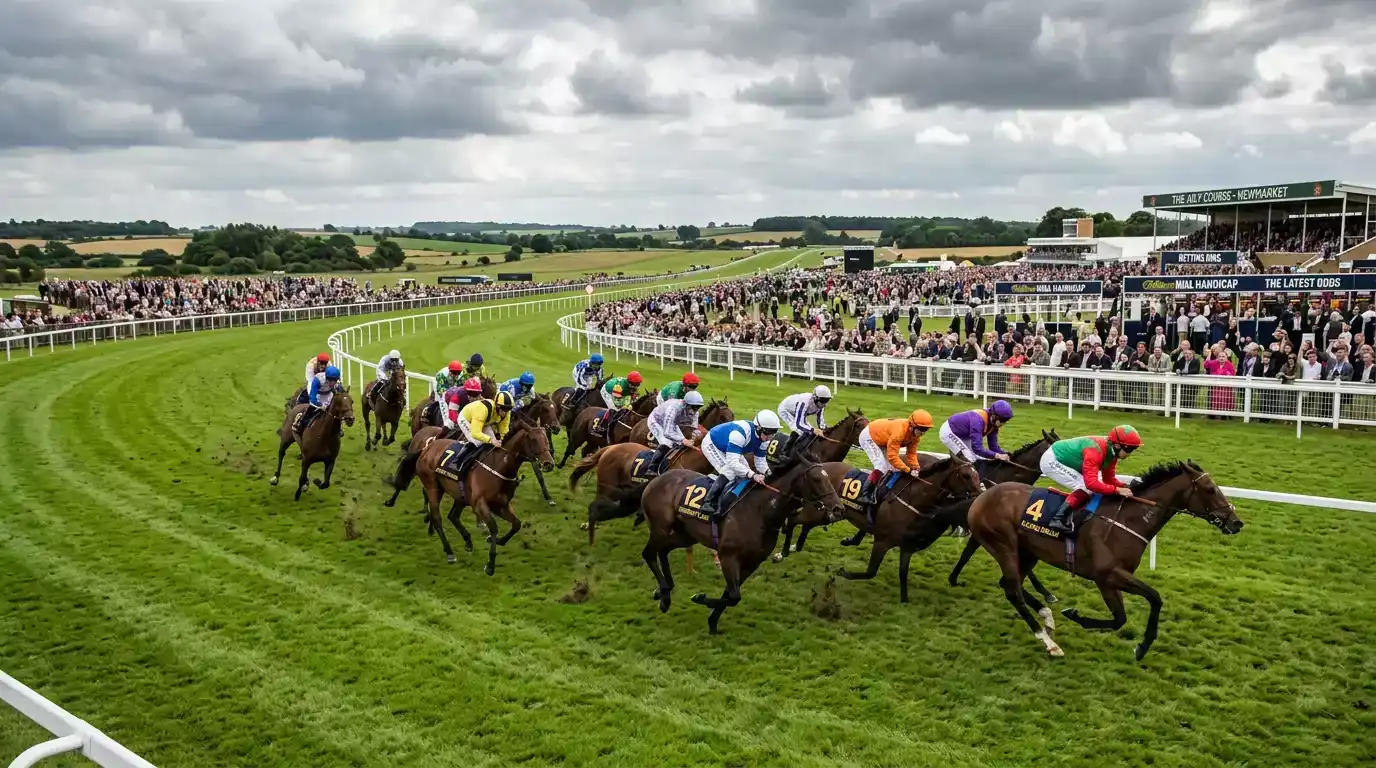
The sweet spot sits in the 12-to-16-runner range. You get three or four paid places, competitive odds across the field, and enough uncertainty that bookmakers cannot price every horse precisely. National Hunt fields tend to be smaller than Flat on average, which means the big handicap chases and hurdles are the exceptions rather than the rule over jumps. When those big fields do appear, the place terms widen and the inefficiencies grow with them.
Going Ground: How to Read It Before You Bet
I once watched a 4/6 favourite plod home sixth on heavy ground at Haydock — a horse with three wins on good-to-firm that had no business being sent off at those odds on a waterlogged track. The market got lazy because the form looked impressive on paper. Going ground is the variable that separates paper form from actual probability, and in place betting it matters even more than in win markets because you need consistent top-three finishes, not a single brilliant run.
The numbers tell the story clearly. Favourites win over 50% of races on good going but only around 20% on heavy ground. That is not a marginal shift — it is a complete inversion of reliability. For place bettors, the implication runs deeper. On good ground, short-priced horses finish in the places at rates that can sustain a level-stakes approach. On heavy ground, the finishing order scrambles. Stamina trumps speed, front-runners tire, and the horses who handle the conditions are not always the ones the market expects.
I check the going report before I check the racecard. If the ground is good or good-to-firm, I lean toward favourites and second favourites in the place market — their strike rates justify shorter prices. When the going turns soft or heavy, I shift toward horses with proven form on that surface, even if they are further down the betting. A 10/1 shot with two wins on heavy ground is a better place bet on a soft day than a 2/1 favourite whose entire form line reads “good to firm.” The going report is free, updated morning and afternoon, and available on every racing site. It is the cheapest edge in the game and most place bettors treat it as background noise.
Favourites in Place Markets: When Odds-On Horses Still Pay
There is a strange prejudice among experienced bettors that backing favourites is somehow beneath them. I held the same view for years, until I ran the numbers on place finishes across 2,000 races and realised that favourites place at rates most people drastically underestimate. The question is not whether to include favourites in a place betting approach. The question is under which conditions their place strike rate exceeds the implied probability baked into the odds.
Start with the raw data. In large fields of 12 or more runners, favourites win about 33% of the time. That does not sound spectacular until you calculate how often they finish in the first three — the place strike rate in those fields sits closer to 60-65%. A horse priced at 3/1 for the win pays roughly 3/4 for a place at 1/4 odds. If it places 63% of the time, the expected value on a place bet is positive. Not dramatically positive, not the kind of edge that makes you rich overnight, but positive. Over 500 bets, that edge compounds.
The trap is small fields. In races with five to seven runners, favourites win at rates above 80%, but the place terms compress to two places at 1/4 odds. A 6/4 favourite in a six-runner race pays just 3/8 for a place — roughly 1.38 in decimal. You need the horse to place more than 72% of the time just to break even at that price, and while favourites in small fields hit that threshold, the margin is razor thin. One unexpected non-runner who turns a seven-runner race into a six-runner race can shift the place terms and eliminate your edge in a single withdrawal.
Where favourites become genuinely powerful in place markets is in big-field handicaps. A handicap with 16 or more runners pays four places at 1/5 odds. The favourite in a 20-runner handicap is typically priced around 6/1 to 10/1, which means the place return is 6/5 to 2/1 — real money, not the penny returns you get from odds-on shots in small fields. The favourite’s place strike rate in these races is lower than in small fields, around 45-55%, but the payout compensates for the lower frequency.
I have a simple rule: I will bet a favourite to place in any race where the place odds exceed 1/1 (evens) in decimal terms and the horse has form on the prevailing going. That typically means races with 10 or more runners where the favourite is priced at 5/1 or longer for the win. Below that threshold, the place return is too thin to absorb the inevitable losing runs. Above it, favourites become the most reliable vehicle in the place betting toolkit, whether you bet each way or place only.
One more nuance: joint favourites. When two horses share favouritism at, say, 7/2, neither has the full weight of market confidence. The place strike rate for each individual joint favourite drops below that of a sole favourite at the same price. I treat joint favourites as mid-range contenders rather than market leaders and adjust my stake accordingly — half what I would put on a sole favourite in the same field conditions.
Identifying Value: Place Odds That Exceed True Probability
Every so often I pull up a racecard and see a horse priced at 14/1 in a 16-runner handicap — a place return of 14/4 (3.5/1) — and I know the horse has finished in the first four in six of its last eight starts on similar ground. The bookmaker has priced the horse to win, not to place, and the place odds are a derivative of that win price. That disconnect between place probability and place odds is where the real value lives in this market.
The concept is straightforward. Bookmakers set win odds based on their assessment of a horse’s chance of finishing first. Place odds are calculated mechanically from win odds — 1/4 or 1/5 of the win price, depending on the race conditions. But the correlation between winning ability and placing ability is not linear. A horse with a 7% chance of winning a 16-runner race (roughly 14/1) does not have a 28% chance of placing in the top four. Horses with consistent late-running styles, proven stamina, and reliable jockeys routinely place at rates well above what their win odds imply.
UK remote horse racing generated 766.7 million pounds in gross gambling yield in the year to March 2025 — a number that tells you the market is deep enough for inefficiencies to persist. Bookmakers cannot hand-craft place odds for every horse in every race. They rely on the mechanical fraction, and that fraction creates systematic mispricings for certain profile types.
The profiles that consistently offer place value share a few traits. First, horses dropping in class. A horse that ran in Group 2 company last month and drops into a Class 3 handicap this week will be priced on its recent finishing positions — seventh, eighth, ninth in strong company — rather than its actual ability relative to today’s field. The win odds look reasonable. The place probability is higher than the odds suggest. Second, front-runners in big fields. A horse that leads from the start and typically fades to third or fourth is poor win value but excellent place value, especially in races with 12 or more runners where three places are paid. Third, proven ground specialists when conditions change during a meeting. If the ground turns soft mid-afternoon and a horse in the last race has three wins on soft, the morning odds will not fully reflect the shift.
I keep a simple tracking sheet. For every place bet I take, I record the implied place probability from the odds and my estimated true probability based on form, going, class and field size. After 200 bets, the comparison tells me whether I am genuinely identifying value or just convincing myself I am. The spreadsheet does not lie, even when my memory does. If your estimated probabilities consistently exceed the implied probabilities by 5% or more and your actual results align with your estimates, you have an edge. If not, you are guessing with a system’s name attached to it.
Staking Methods for Place Betting: Level, Proportional and Target
I spent my first two years place betting with what I now call the “feelings method” — bigger stakes when I felt confident, smaller stakes when I did not. My results were a mess. Not because my selections were bad, but because my staking amplified losses on the confident picks that lost and minimised gains on the tentative picks that won. The selections were doing their job. The staking was sabotaging the operation.
Three staking methods work for place betting, and each fits a different personality. Level staking is the simplest: you bet the same amount on every selection regardless of odds or confidence. If your edge is real, level staking will reveal it over time without the noise of variable stakes. The downside is that it treats a 2/1 place shot and a 7/1 place shot identically, which ignores the different risk profiles. For beginners, this is the right method. It removes one source of error while you learn whether your selections actually produce value.
Proportional staking — betting a fixed percentage of your current bankroll on each selection — adjusts automatically for winning and losing runs. A 2% bankroll stake means your bets grow when you are winning and shrink when you are losing, which protects capital during drawdowns and accelerates growth during profitable streaks. The discipline required is real: when your bankroll drops 30% and your stake drops with it, the emotional urge to increase stake size to “win it back” is overwhelming. Proportional staking only works if you actually follow it.
Target staking inverts the logic. Instead of a fixed stake, you set a fixed return and calculate the stake needed to achieve it. If your target return is 10 and the place odds are 2/1, you stake 5. If the place odds are 5/1, you stake 2. This method naturally puts more money on shorter-priced selections and less on longer shots, which aligns well with place betting because shorter-priced horses place more frequently. The risk is that a losing run on short-priced selections costs more per loss than a losing run on longer shots.
I use proportional staking at 1.5% of my bankroll per bet, adjusted quarterly. It is boring. It is mechanical. It works.
Seasonal Patterns at a Glance: When to Shift Your Approach
The British racing calendar is not uniform, and treating it as one continuous season is a mistake I see place bettors make constantly. The Flat turf season runs roughly from April to October, with the largest and most competitive fields appearing at the big festival meetings — Royal Ascot, Glorious Goodwood, York’s Ebor meeting. These are the weeks when handicap fields regularly hit 16 or more runners and place terms extend to four places. The BHA has projected that race numbers could fall 6-7% by 2027 compared to 2024, which will concentrate runners into fewer races and potentially push average field sizes higher at the meetings that survive.
National Hunt dominates from October to April. Field sizes are smaller on average, but the championship meetings — Cheltenham in March, Aintree in April — produce the biggest fields of the entire racing year. The Grand National regularly draws 40 runners. The Cheltenham Festival features handicaps with 20 or more runners across multiple days. These are the events where place betting carries the most structural potential because the place terms are at their widest and the bookmaker margins are stretched across the most outcomes.
Between the festivals, midweek racing at smaller tracks — Plumpton, Sedgefield, Ffos Las — features fields that rarely break double figures. I reduce my place betting activity during these quiet spells and focus on value identification rather than volume. The all-weather circuit runs year-round at Kempton, Lingfield, Chelmsford and Wolverhampton, providing a steady flow of medium-field races that suit place betting during the winter months when jumps fields are small and Flat turf is dormant.
Bankroll Management: Protecting Capital Across a Place Betting Campaign
Alan Delmonte, CEO of the Horserace Betting Levy Board, put it bluntly when discussing the industry’s financial structure: bookmaker gross profits from racing are what fund the sport’s prize money and integrity systems. That money comes from bettors who lose more than they win. If you want to be on the other side of that equation — and stay there — bankroll management is not optional. It is the foundation that everything else rests on.
Start with a number you can afford to lose entirely. Not a number that would hurt. Not a number you hope to grow. A number you can write off as the cost of a year’s entertainment if everything goes wrong. That is your bankroll. For most recreational bettors serious about place betting as a structured activity, something between 500 and 2,000 makes sense as a starting bankroll. Less than that, and the individual bet sizes become too small to generate meaningful returns. More than that, and the emotional weight of losses starts distorting decisions.
Set a maximum bet size as a percentage of that bankroll — I use 1.5%, others use 1% or 2% — and do not deviate. A 1,000 bankroll at 1.5% means 15 per bet. If the bankroll drops to 700 after a losing run, the bet drops to 10.50. That mechanical reduction is what keeps you in the game during the inevitable drawdowns. Every place bettor will experience losing runs of 10, 15, even 20 bets. At 1.5% per bet, a 20-bet losing run reduces your bankroll by about 26%. Painful, but recoverable. At 5% per bet, that same losing run wipes out 64% of your capital and puts you in a hole that requires a 178% gain to climb out of.
Review your results monthly. Not daily — daily reviews amplify noise and encourage tinkering. Monthly reviews smooth out variance and show trends. Track your return on investment, your strike rate, and your average place odds. If your ROI is negative after 300 bets with a consistent approach, the approach is not working and no amount of bankroll management will fix it. If your ROI is positive, the bankroll management is what allows the edge to express itself over time. The maths is patient. You have to be as well.
See also: compare the two approaches in our each-way vs place bet breakdown.
FAQ
What is the best field size for place betting on UK horse racing?
The most productive range sits between 12 and 16 runners. These races pay three or four places depending on whether the race is a handicap, and the competitive nature of larger fields creates pricing inefficiencies that favour disciplined place bettors. Races with fewer than eight runners compress place terms to two places at 1/4 odds, which rarely offers enough margin to sustain a profitable approach over time.
Do favourites make good place bets?
In large fields of 10 or more runners, favourites place at rates between 55% and 65%, which often exceeds the probability implied by their place odds. The key condition is that the place return needs to exceed evens in decimal terms — typically when the favourite is priced at 5/1 or longer for the win. In small fields, favourites place very reliably but the compressed place terms reduce returns below useful levels.
How much of my bankroll should I stake on each place bet?
Between 1% and 2% of your total bankroll per bet is the range used by most disciplined place bettors. A 1.5% stake limits the damage from inevitable losing runs while allowing meaningful returns during profitable periods. At this level, even a 20-bet losing streak reduces your bankroll by roughly 26% rather than destroying it entirely.
Does going ground really affect place betting results?
Significantly. Favourites win over 50% of races on good going but only about 20% on heavy ground. That shift in reliability cascades through the entire field and changes which horses offer place value. Checking the going report before the racecard is one of the simplest and most effective filters a place bettor can apply.
Published by the Place bet Horse Racing team.