UK Place Odds Are Not What They Seem at First Glance
 Available in US

- UK Place Odds Are Not What They Seem at First Glance
- Fractional Odds Refresher: Reading a UK Racecard
- The Place Fraction Formula: From Win Odds to Place Odds
- 1/4 Odds vs 1/5 Odds: Worked Calculations for Each
- Rule 4 at a Glance: What It Means for Place Payouts
- Dead Heats in Brief: How They Reduce a Place Payout
- SP and BOG: Which Matters for Place Bet Pricing
- The Maths That Sits Behind Every Place Bet Payout
UK Place Odds Are Not What They Seem at First Glance
Three years ago, I ran a simple experiment. I asked fifty regular horse racing bettors at Ascot to tell me the place odds on a 10/1 shot in a twelve-runner non-handicap race. Thirty-eight of them could not answer. Of the twelve who tried, only five got it right. The other seven guessed 5/1, which is exactly double the correct answer. If seasoned racegoers cannot calculate a basic place payout, the industry has a communication problem — and your wallet is paying for it.
Place bet odds in the UK are not displayed on the racecard. They are not printed on the betting slip before you stake. They exist as a derivative of two other numbers — the win odds and the place fraction — and unless you know how to combine those numbers, the payout you receive when your horse finishes second or third will always feel like a surprise. Sometimes a pleasant one. Often not.
UK horse racing generated 766.7 million pounds in remote betting gross gambling yield in the year to March 2025, and a significant portion of that revenue depends on bettors not fully understanding the maths behind their place payouts. That sounds cynical, but it is structural: the less precisely a bettor understands place odds, the less effectively they can assess value, and the greater the bookmaker’s effective margin.
This guide is my attempt to fix that, one calculation at a time. I will start with the fractional odds system that underpins UK racing, move into the place fraction formula, work through detailed examples at both 1/4 and 1/5 rates and then cover the edge cases — Rule 4 deductions, dead heats, and the choice between SP and Best Odds Guaranteed — that can alter your payout after the race has been run. By the end, you will be able to calculate the exact return on any place bet in under ten seconds.
See also: place bet horse racing for odds formats and payout guides.
Fractional Odds Refresher: Reading a UK Racecard
Before we touch place odds, we need to be speaking the same language about win odds. UK horse racing runs on fractional odds — a system that confuses even some experienced punters who grew up with decimal pricing on football or tennis markets. I will keep this brief, but getting it right here saves errors everywhere downstream.
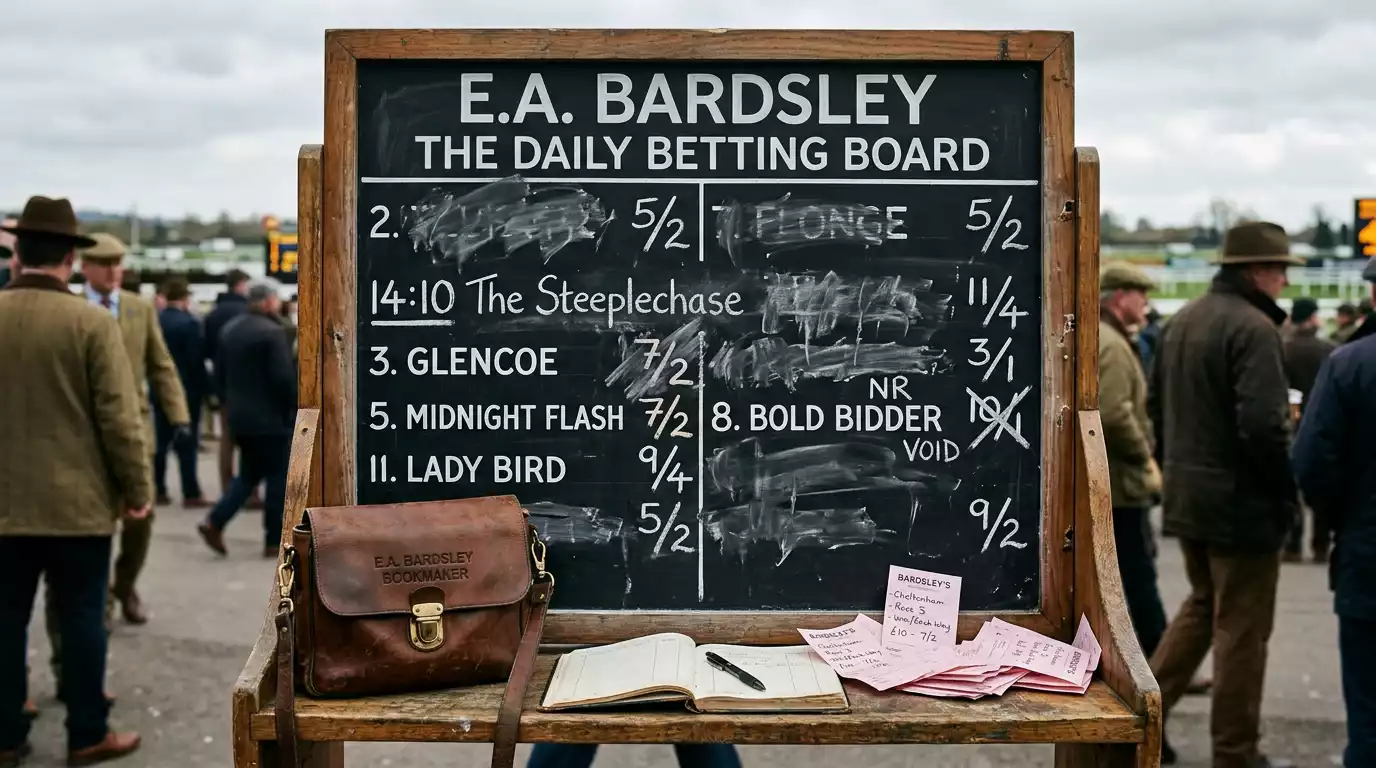
Fractional odds express the profit you receive relative to your stake. A horse priced at 5/1 returns five pounds of profit for every one pound staked, plus your stake back. Total return on a 10 pound bet at 5/1: 60 pounds (50 pounds profit + 10 pounds stake). At 7/2, the profit is three and a half pounds for every one pound staked — 45 pounds total return on a 10 pound bet (35 pounds profit + 10 pounds stake).
The numerator is profit, the denominator is the stake required to generate that profit. When the numerator is larger than the denominator — 5/1, 10/1, 33/1 — the horse is an outsider and the profit exceeds the stake. When they are close to equal — 6/5, 11/10, evens — the horse is near the top of the market. When the denominator is larger — 1/2, 4/9, 2/7 — the horse is odds-on, and you need to stake more than you stand to profit.
For place bet calculations, you need to be comfortable converting the fractional odds into a single number. At 5/1, the multiplier is 5.0. At 7/2, it is 3.5. At 11/4, it is 2.75. The formula is straightforward: divide the numerator by the denominator. This gives you the profit multiplier per pound staked, which is the number you will feed into the place fraction formula in the next section.
One common source of confusion: odds like 100/30 are sometimes displayed on UK racecards, particularly on the Tote or in less liquid markets. These reduce to 10/3, which is a multiplier of 3.33 recurring. You can round to 3.33 for practical purposes without meaningful loss of accuracy. The same applies to any odds that produce a repeating decimal — the rounding error on a 10 or 20 pound bet is a matter of pence.
A quick note on the relationship between fractional odds and implied probability, which becomes important when we start assessing value later. The implied probability of any fractional odds is calculated as denominator divided by (numerator + denominator). At 5/1, that is 1 divided by 6 = 16.7%. At 7/2, it is 2 divided by 9 = 22.2%. At evens, it is 1 divided by 2 = 50%. These percentages are not the horse’s true chance of winning — they include the bookmaker’s margin — but they are the starting point for any value assessment. I will revisit this concept when we look at place odds specifically, because the implied probability of a place outcome is fundamentally different from the implied probability of a win.
The Place Fraction Formula: From Win Odds to Place Odds
Every place bet payout in UK horse racing flows from a single formula, and once you have it, you never need to guess again. I call it the most important equation in betting that nobody writes on a whiteboard — which is odd, because it takes about three seconds to learn.
Place odds = Win odds multiplied by the place fraction.
That is it. The place fraction is either 1/4 or 1/5, depending on the race type and field size. For most races — non-handicaps with eight or more runners, handicaps with fewer than sixteen runners and races with five to seven runners — the fraction is 1/4. For handicap races with sixteen or more runners, the fraction is 1/5.
Let me make this concrete. Your horse is 8/1 in a ten-runner conditions stakes. The place fraction is 1/4. Place odds = 8 divided by 4 = 2/1. A 10 pound place bet returns 30 pounds (20 pounds profit + 10 pounds stake).
Same horse, same odds, but now it is running in an eighteen-runner handicap. The place fraction is 1/5. Place odds = 8 divided by 5 = 8/5. A 10 pound place bet returns 26 pounds (16 pounds profit + 10 pounds stake). The difference — 4 pounds less profit on the same stake and the same win price — is entirely driven by the fraction.
For fractional odds where the numerator is not cleanly divisible by the fraction denominator, the result is an unfamiliar-looking fraction that bookmakers display differently across platforms. A 7/1 horse at 1/4 terms produces place odds of 7/4. That is straightforward. But a 9/2 horse at 1/4 produces 9/8 — technically correct but visually awkward. Some bookmakers convert this to decimal (2.125) on the betslip, others round to the nearest common fraction. The underlying maths does not change regardless of how it is displayed.
The formula also works in reverse, which is useful for checking your betslip. If a bookmaker shows you place odds of 5/2 on a horse priced at 10/1, you can verify: 10 divided by 4 = 2.5, which is 5/2. Correct — 1/4 terms. If the place odds show 2/1 on the same 10/1 horse, that implies 10 divided by 5 = 2, meaning 1/5 terms are being applied. You can now immediately see whether the bookmaker is using the standard fraction or a reduced one.
I run this mental check on every place bet I make, without exception. It takes two seconds and has caught discrepancies more than once — typically on enhanced place offers where the fraction has been quietly reduced from 1/4 to 1/5. The formula is your quality control tool. Learn it, use it, and never accept a place payout without knowing whether it is correct.
One critical point that trips up even experienced punters: the fraction applies to the odds, not to the total return. A 10/1 horse at 1/4 terms pays 10/4 = 5/2 in place odds — meaning 2.5 times your stake in profit, plus your stake back. Some bettors mistakenly calculate 1/4 of the total win return (which would include the stake), arriving at a higher number. The fraction applies only to the profit portion of the odds. Getting this wrong inflates your expected return and leads to systematic overvaluation of place bets.
1/4 Odds vs 1/5 Odds: Worked Calculations for Each
I find that worked examples settle confusion faster than any amount of explanation. Let me take a single horse at a single price and run it through both fraction scenarios so you can see exactly where the money goes, pound by pound.
The horse is priced at 14/1 to win. Your stake is 10 pounds. The horse finishes third — well within the places under either three-place or four-place terms.
Under 1/4 terms (the standard for most UK races), place odds are 14 divided by 4 = 14/4, which simplifies to 7/2. Your 10 pound place bet returns: 10 pounds multiplied by 3.5 = 35 pounds profit, plus your 10 pound stake returned = 45 pounds total. Net profit: 35 pounds.
Under 1/5 terms (for handicaps with 16+ runners), place odds are 14 divided by 5 = 14/5, which is 2.8/1. Your 10 pound place bet returns: 10 pounds multiplied by 2.8 = 28 pounds profit, plus your 10 pound stake returned = 38 pounds total. Net profit: 28 pounds.
The difference is 7 pounds — a 20% reduction in profit. On a single 10 pound bet, that might feel marginal. Across a hundred bets at this price point, it is 700 pounds. That is not marginal; it is a season’s worth of variance.
Let me run a second example at a shorter price to show how the fraction effect changes. The horse is 4/1, stake is 20 pounds, and it finishes in the places.
At 1/4 terms: place odds = 4 divided by 4 = 1/1 (evens). Return: 20 pounds profit + 20 pounds stake = 40 pounds. Net profit: 20 pounds.
At 1/5 terms: place odds = 4 divided by 5 = 4/5. Return: 16 pounds profit + 20 pounds stake = 36 pounds. Net profit: 16 pounds.
Here the difference is 4 pounds on a 20 pound bet. The percentage reduction is still 20% — the fraction effect is proportionally consistent across all odds. This is a point worth internalising: moving from 1/4 to 1/5 always costs you exactly 20% of your place profit, regardless of the win odds. The absolute pound difference grows with longer odds, but the proportional impact is fixed.
A third example at the top end of the market. The horse is 33/1, stake is 5 pounds.
At 1/4 terms: place odds = 33/4 = 8.25/1. Return: 41.25 pounds profit + 5 pounds stake = 46.25 pounds. Net profit: 41.25 pounds.
At 1/5 terms: place odds = 33/5 = 6.6/1. Return: 33 pounds profit + 5 pounds stake = 38 pounds. Net profit: 33 pounds.
The gap is now 8.25 pounds on a 5 pound stake. At longer odds, the absolute cost of the 1/5 fraction bites harder. This is why experienced place bettors pay close attention to the fraction on big-field handicaps — the four-place concession adds a qualifying position, but the 1/5 fraction extracts a price for it that is steepest on longer-priced selections.
The average UK field sizes — 8.90 Flat, 7.84 National Hunt — mean that most of your place bets will settle at 1/4 terms. But when you do venture into the sixteen-plus handicap territory, run the 1/5 calculation before you stake. The apparent generosity of four places can mask a payout that is less impressive than it first appears.
Converting Place Fractions to Decimal for Comparison
If you bet across multiple sports or use an exchange, you probably think in decimal odds. Converting place fractions to decimal is one extra step, but it makes comparison between bet types, bookmakers and platforms straightforward.
The conversion formula: decimal place odds = (fractional place odds) + 1. A horse at 7/2 place odds in fractional terms becomes 4.50 in decimal. At 14/5, it becomes 3.80. At evens (1/1), it is 2.00. The “+1” accounts for the stake return that decimal odds include by default.
Why bother? Because decimal odds let you compare place prices across different formats instantly. If one bookmaker shows 7/2 place odds on a horse and an exchange shows 4.20 on the same horse, you can immediately see that 4.50 is better than 4.20 without converting both to the same format in your head. Decimal removes the mental arithmetic layer that fractional odds impose.
Decimal odds also make it easier to calculate implied place probability. The formula is: 1 divided by the decimal odds. At 4.50, the implied place probability is 22.2%. At 3.80, it is 26.3%. At 2.00, it is 50%. These percentages are bookmaker-adjusted (they include margin), but they give you a quick benchmark for assessing whether the place odds on offer represent value against your own estimate of the horse’s chance of finishing in the places.
I keep a simple conversion table bookmarked for the most common place odds. For 1/4 terms: 3/1 becomes 4.00, 5/2 becomes 3.50, 2/1 becomes 3.00, 7/4 becomes 2.75, 6/4 becomes 2.50, evens becomes 2.00. For 1/5 terms at the same win prices, every number drops by roughly 15-20% in decimal. Having these memorised — or at least accessible — speeds up the decision-making process at the critical moment between seeing the odds and placing the bet.
Rule 4 at a Glance: What It Means for Place Payouts
A late withdrawal after you have placed your bet triggers a Rule 4 deduction — a percentage cut from your winnings designed to reflect the shortened field. The deduction scale runs from 5p in the pound for a long-priced withdrawal to 90p in the pound if the favourite is pulled out, and it applies to both the win and place portions of any bet settled after the withdrawal.
For place bets specifically, Rule 4 bites harder than most people expect. Your place odds are already a fraction of the win odds, so a further percentage deduction on top of that fraction compresses the payout significantly. A 10/1 horse at 1/4 terms pays 5/2 on a place. If a Rule 4 deduction of 20p in the pound applies, your effective return drops by 20% on that already-reduced price. The mechanics are straightforward but the cumulative effect is painful.
I cover the full deduction scale and worked place bet examples in my dedicated Rule 4 deductions guide. For now, the key takeaway is this: whenever you see a late withdrawal on a race you have already backed, check the deduction level immediately. It changes the expected value of your bet, and in some cases, it can turn a profitable position into a losing one.
Dead Heats in Brief: How They Reduce a Place Payout
Dead heats for a place are rarer than most punters think, but when they happen, they cut your payout in a way that feels disproportionate. If two horses dead-heat for the last qualifying place — say, for third in a three-place race — the standard settlement halves your stake for that bet and pays out the place odds on the reduced stake. The other half of your stake is treated as a loser.
On a 10 pound place bet at 5/2 odds, a two-way dead heat returns: 5 pounds (half your stake) multiplied by 2.5 = 12.50 pounds profit, plus the 5 pound qualifying stake = 17.50 pounds. The other 5 pounds is lost. Your net result is 7.50 pounds profit instead of the 25 pounds you would have received without the dead heat.
Three-way dead heats divide further, and the maths gets progressively less pleasant. The principle is always the same: your stake is divided by the number of horses sharing the position, and only the qualifying portion pays out. I walk through multi-way dead heats and edge cases in my full guide to dead heat rules for place bets.
SP and BOG: Which Matters for Place Bet Pricing
Starting Price and Best Odds Guaranteed interact with place odds in ways that can materially affect your return, and most bettors give them far less attention than they deserve. SP is the price determined by on-course bookmakers at the moment the race starts. BOG is a promotional guarantee that if you take a fixed price and the SP is higher, you get paid at the better price.
For place bets, BOG applies to the win odds before the place fraction is calculated. If you back a horse at 8/1 and the SP drifts to 12/1, your place odds under BOG and 1/4 terms become 12/4 = 3/1, not the 8/4 = 2/1 you originally took. That difference — an extra pound of profit per pound staked — is entirely free. At the Cheltenham Festival 2026, bet365 paid out over 50 million pounds through its Best Odds Guaranteed programme, which gives you a sense of how much value BOG transfers from bookmaker to bettor across an event.
HBLB CEO Alan Delmonte noted that bookmakers’ gross profits in early 2025 ran well above recent norms, driven partly by bookmaker-friendly results at the Cheltenham Festival. That profitability is what funds BOG and similar promotions. When margins contract, BOG may tighten. Until it does, taking an early price with BOG is almost always preferable to taking SP for place bets, because you capture both the upside of a drift and the security of a floor.
See also: learn how place terms vary by field size and race type.
The Maths That Sits Behind Every Place Bet Payout
Place odds are a derived product — they depend on the win odds, the fraction and the race conditions, all before deductions or dead heats enter the picture. The bettor who understands how each layer works can audit their own payouts, spot discrepancies and assess value with precision that the casual punter simply cannot match. Run the formula, check the fraction, verify the settlement. That three-step habit is worth more than any tipster subscription.
What is the difference between 1/4 and 1/5 place fractions in practice?
The 1/4 fraction returns 25% of the win odds as place odds, while 1/5 returns 20%. On a 10/1 horse, 1/4 gives place odds of 5/2, while 1/5 gives 2/1. The 1/5 fraction always reduces your place profit by exactly 20% compared to 1/4, regardless of the win price. It applies to handicap races with sixteen or more runners.
How does Rule 4 change my place bet payout after a late withdrawal?
Rule 4 deducts a percentage from your winnings based on the price of the withdrawn horse. The deduction applies to your place payout after the place fraction has been calculated. A 20p in the pound deduction means you receive 80% of your normal place profit. The deduction scale ranges from 5p to 90p depending on how short-priced the withdrawn horse was.
Are place bet odds better at SP or with Best Odds Guaranteed?
Best Odds Guaranteed is almost always preferable for place bets. BOG gives you the higher of your fixed price or SP, and the place fraction is applied to whichever odds are used. If you take 8/1 and SP drifts to 12/1, your place odds improve from 2/1 to 3/1 under 1/4 terms. SP only beats BOG if the price shortens after you bet, in which case BOG reverts to your original price anyway.
How do I convert fractional place odds to decimal?
Add 1 to the fractional value. Place odds of 5/2 in fractional terms are 2.5 as a number, so decimal odds are 2.5 + 1 = 3.50. Place odds of 7/4 are 1.75 as a fraction, so decimal is 2.75. Decimal odds include the stake return, which is why you add 1. This conversion makes it easier to compare prices across bookmakers and exchanges.
Prepared by the Place bet Horse Racing editorial staff.