Two Bets, One Place Finish — Why the Choice Matters
 Available in US
- Two Bets, One Place Finish — Why the Choice Matters
- How an Each-Way Bet Splits Into Win and Place
- How a Place-Only Bet Works and When to Use It
- Side-by-Side Payout: 10 Each-Way vs 20 Place Only
- Breakeven Strike Rates: Each-Way vs Place Only by Odds Range
- Place Markets on Betting Exchanges: A Third Option
- Choosing the Right Bet Type for Every Race
Two Bets, One Place Finish — Why the Choice Matters
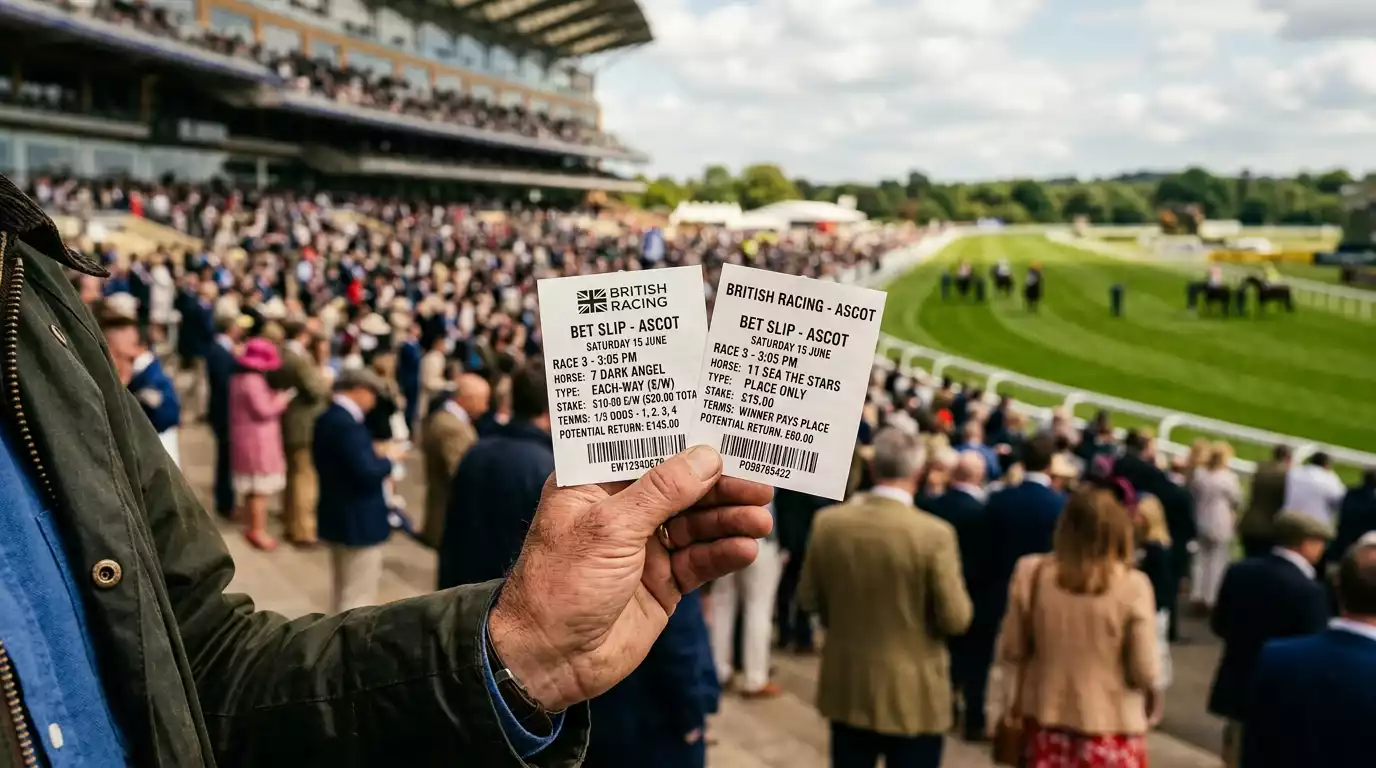
Last spring, a reader sent me a screenshot of two betting slips from the same Saturday card at Newbury. Both were on the same 14/1 shot. One was a 10 pound each-way bet, the other a 20 pound place-only bet. The horse finished third. The each-way slip returned 22.50 pounds. The place-only slip returned 90 pounds. Same horse, same race, same finishing position — and one bet paid four times the other. He wanted to know why.
The answer lies in how UK horse racing structures these two bet types, and why choosing between them is not the afterthought most punters treat it as. An each-way bet is two bets in one: a win stake and a place stake, each costing the same amount. A place-only bet concentrates your entire stake on the place outcome alone. The total outlay can be identical, but the distribution of risk and reward is completely different.
Remote betting on UK horse racing generated 766.7 million pounds in gross gambling yield in the year to March 2025 — the second-largest sport behind football. A meaningful chunk of that revenue flows through each-way and place markets, yet the decision between the two is one that most bettors make on autopilot. They click “each way” because it feels like a safety net, without running the numbers on whether that safety net is actually worth its cost.
Over the next few sections, I will break both bet types down to their mechanical components, run side-by-side payout comparisons and calculate the breakeven strike rates that tell you — objectively — which bet gives better expected value across different odds ranges. This is not a question of preference. It is a question of maths, and the maths has a clear answer in most scenarios.
See also: place bet horse racing for each-way and place-only comparisons.
How an Each-Way Bet Splits Into Win and Place
I remember the moment each-way betting finally clicked for me. I was standing in a Ladbrokes shop in Newmarket, staring at a slip that said “10 pounds e/w” and realising for the first time that it meant 20 pounds total — not 10. That misunderstanding is more common than anyone in the industry admits, and it is the starting point for understanding why each-way bets behave the way they do.
An each-way bet is literally two separate bets stapled together. The first is a win bet at the full win odds. The second is a place bet at a fraction of the win odds, determined by the place terms applicable to the race. When you stake 10 pounds each way, you are putting 10 pounds on your horse to win and 10 pounds on your horse to place. Total stake: 20 pounds.
If the horse wins, both bets pay out. The win portion returns at the full win odds, and the place portion returns at the place fraction — typically 1/4 of the win odds for most races, or 1/5 for handicaps with sixteen or more runners. If the horse places but does not win, only the place portion pays. The win portion loses entirely. If the horse finishes outside the places, both portions lose.
Let me walk through a concrete example. You back a horse at 12/1 each way for 10 pounds in a ten-runner non-handicap race. Three places are paid at 1/4 odds.
Scenario one — the horse wins. Your win bet returns 10 pounds times 12/1 = 120 pounds profit, plus your 10 pound stake back = 130 pounds. Your place bet returns 10 pounds times 3/1 (12 divided by 4) = 30 pounds profit, plus your 10 pound stake back = 40 pounds. Total return: 170 pounds on a 20 pound outlay. Net profit: 150 pounds.
Scenario two — the horse finishes second. Your win bet loses. You are down 10 pounds. Your place bet returns 10 pounds times 3/1 = 30 pounds profit, plus your 10 pound stake back = 40 pounds. Total return: 40 pounds on a 20 pound outlay. Net profit: 20 pounds.
Scenario three — the horse finishes fifth. Both bets lose. Total return: zero. Net loss: 20 pounds.
The crucial dynamic to grasp is that the win portion acts as a drag on profitability whenever the horse places but does not win. You are paying for two bets but only collecting on one. The win stake is dead money in a place-only outcome. This is the structural weakness of each-way betting that most guides gloss over — the win half costs you money every time it does not fire, and in my experience, the majority of each-way bets that return a profit do so through the place portion alone.
That does not make each-way bets bad. It makes them a specific tool for a specific purpose: situations where you believe the horse has a genuine winning chance AND a high place probability. If you are backing a horse purely because you think it will finish in the frame without winning, the each-way structure forces you to fund a win bet you do not actually believe in.
How a Place-Only Bet Works and When to Use It
Place-only betting strips away the win component entirely. Your stake goes on one outcome: the horse finishes in the places. Nothing more, nothing less. It sounds like the simpler product, and mechanically it is — but finding it on a bookmaker’s site can be oddly difficult, which is why many punters default to each-way without considering the alternative.
Most UK bookmakers do offer place-only markets, but they are not always displayed alongside the standard win odds. Some operators require you to navigate to a separate “place betting” tab or select “place only” from a dropdown menu after clicking on the horse. Others display place odds automatically in the betslip once you tick a box. The inconsistency in presentation is a design choice, not a technical limitation — each-way bets generate twice the stake per customer interaction, which is why operators tend to push them more prominently.
The mechanics are straightforward. You select a horse, choose the place-only market and stake your chosen amount. The odds you receive are the place odds for that race, which correspond to the win odds multiplied by the applicable fraction. On a 12/1 shot in a race paying 1/4 odds, the place-only price is 3/1. Your 20 pound stake returns 80 pounds if the horse places (60 pounds profit plus 20 pounds stake). If the horse does not place, you lose 20 pounds.
With average UK field sizes at 8.90 on the Flat, most races offer three qualifying places — a meaningful proportion of the field. Place-only betting makes particular sense when you have strong form evidence that a horse will finish in the first three or four but lacks the tactical speed, the jockey booking or the draw to win outright. Consistent place performers — the types that regularly hit the frame without quite getting their head in front — are the natural candidates for this bet type. I go into the full detail on how to find and use standalone place bets in a dedicated article.
The place-only market is also the default on betting exchanges, where you back or lay a horse to place at odds set by other users. Exchange place odds can differ significantly from the bookmaker equivalent because they are driven by supply and demand rather than calculated from a fraction of the win price. That distinction becomes important when we compare the three options later in this article.
Side-by-Side Payout: 10 Each-Way vs 20 Place Only
Numbers settle arguments faster than opinions. Let me take the same 20 pounds and show you exactly where it ends up under both bet types, across three different finishing positions, at three different price points. The race is a ten-runner non-handicap — three places paid at 1/4 odds.
Horse A is priced at 6/1. With 10 pounds each way (20 pounds total), a win returns 130 pounds (60 pound win profit + 10 pound win stake + 15 pound place profit + 10 pound place stake, minus 20 pound total outlay = 110 pound net profit). A place-only finish returns 25 pounds (15 pound profit + 10 pound stake, minus the 10 pound losing win bet = 5 pound net profit). Outside the places: minus 20 pounds. Now take the same 20 pounds as a place-only bet at 6/4 (that is 6 divided by 4, the 1/4 fraction of 6/1). A place finish returns 50 pounds (30 pound profit + 20 pound stake = 30 pound net profit). Outside the places: minus 20 pounds.
The difference on a place finish is stark. Each way yields 5 pounds net profit. Place only yields 30 pounds. Six times more, from the same 20 pounds, on the same outcome.
Horse B is 12/1. Each way: a win returns 170 pounds net profit. A place finish returns 20 pounds net profit (40 pounds place return minus 20 pounds outlay). Place only at 3/1: a place finish returns 60 pounds net profit. The gap narrows slightly at higher odds because the place fraction generates a better return, but place only still triples the each-way place profit.
Horse C is 25/1. Each way: a win returns 320 pounds net profit. A place finish returns 42.50 pounds net profit (62.50 pounds place return minus 20 pounds outlay). Place only at 25/4 (6.25/1): a place finish returns 125 pounds net profit. Place only delivers nearly three times the each-way return on a place outcome.
The pattern is consistent across every odds range I have tested. When the horse places but does not win, place-only bets generate substantially higher profit from the same total stake. The each-way bet only outperforms when the horse wins, because the win portion then contributes its full return. For a horse at 6/1, the each-way win profit is 110 pounds versus zero additional win profit on a place-only bet (since you never had a win stake). That 110 pound gap is the premium you are paying — through the win half of every each-way bet — for the upside of a win.
The question, then, is how often your horse needs to win to justify that premium. And that is where breakeven strike rates come in.
Breakeven Strike Rates: Each-Way vs Place Only by Odds Range
Every experienced bettor I know uses strike rates as a compass. Not because a single number tells you everything, but because it tells you the minimum threshold your selections need to clear before you even begin to turn a profit. The breakeven strike rate is different for each-way and place-only bets, and the gap between them widens as the odds shorten.
For a place-only bet, the calculation is direct. At place odds of 3/1 (derived from a 12/1 win price at 1/4), your breakeven strike rate is 1 divided by (3 + 1) = 25%. You need your selections to place at least one in four times to break even before any edge. At place odds of 6/4 (from a 6/1 win price), breakeven is 1 divided by 2.5 = 40%. Shorter place odds demand higher hit rates — no surprise there.
For each-way bets, the breakeven calculation is more complex because you need to model three outcomes: win, place-only and miss. The win component raises the breakeven place strike rate because every losing win half drags down your bottom line. At 6/1 each way, you need a combined win-and-place strike rate above approximately 50% to break even, and even then, the split between wins and places matters enormously. If all your returns come from place finishes with zero wins, your 6/1 each-way bets need to place roughly 80% of the time to cover the dead win stakes. That is an unrealistic target for any sustained betting campaign.
At 12/1 each way, the breakeven dynamics shift. The win portion pays enough when it hits to subsidise more place-only returns, so the overall place strike rate needed drops to around 35-40%. At 25/1, it drops further still. Longer-priced each-way selections are more forgiving because the occasional win delivers a substantial surplus that covers a string of place-only outcomes and losses.
Favourites in UK racing win approximately 33% of races in large fields but over 80% in small ones. Those figures translate directly into place probabilities, which are always higher than win probabilities by definition. A horse with a 33% chance of winning might have a 55-60% chance of placing in a twelve-runner race. The question is whether that 55-60% is high enough to justify the each-way structure or whether place only would deliver a better return on capital.
My rule of thumb, refined over thousands of bets: if I rate a horse’s place probability above 40% but its win probability below 15%, place only is almost always the sharper bet. The win half of an each-way wager is too unlikely to fire often enough to justify its cost. If the win probability sits above 20%, each way starts to make sense because the occasional win payout provides meaningful uplift. Between 15% and 20%, it is a coin flip — and in those margins, I default to place only because I prefer to keep my capital concentrated on the outcome I believe in most strongly.
None of this is abstract. On the Flat, where going conditions on good ground push favourite strike rates above 50%, each-way bets on well-backed horses in small fields can be perfectly rational. Over jumps, where heavy ground drops strike rates towards 20%, place-only betting on mid-priced contenders tends to offer better expected value.
Scenarios Where Each-Way Outperforms Place Only
I back each way when the race shape gives my selection a live winning chance — not just a theoretical one. The clearest scenario is a well-handicapped horse stepping up in trip for the first time, where the stamina test could unlock improvement the market has not priced in. If it handles the distance, it wins. If it does not quite stay, it fades late but holds a place. That dual outcome justifies splitting the stake across win and place.
Big-field handicaps at festivals are another natural fit. A 20/1 shot in the Cesarewitch with a genuine pace angle has enough upside on the win portion to make the each-way structure worthwhile. If it wins, the 20/1 return on the win half transforms the entire bet into a substantial profit even after accounting for every place-only outcome across the day. The maths only works at these longer prices — the win payout needs to be large enough to compensate for all the times the win half dies.
Ante-post markets are a third scenario where each way makes sense. Odds are typically longer before race day, which means the win portion carries more value. A 33/1 ante-post each-way bet on a Cheltenham Festival handicap is a different proposition from a 12/1 each-way bet on the same horse on the morning of the race. The ante-post price gives the win half genuine profit potential that narrows the gap with place only.
The common thread across all these scenarios is a genuine win probability above 15-20% combined with odds long enough to make the win payout meaningful. If either condition is missing, each way is the wrong tool.
Scenarios Where Place Only Is the Sharper Bet
Place only dominates when I have identified a horse that profiles as a solid frame contender without a realistic winning chance. This is more common than you might think. Consistent types that hit the first three in six or seven out of ten starts but rarely get their head in front are everywhere in UK racing — particularly in mid-range Flat handicaps and National Hunt staying chases.
Short-priced horses in competitive fields are another strong place-only candidate. Backing a 5/2 favourite each way in a twelve-runner race is a poor use of capital. The place odds are tiny (5/8 at 1/4 terms), and the win half eats into your return every time the horse places without winning. A 20 pound place-only bet at 5/8 returns 12.50 pounds profit. The same 20 pounds each way returns just 6.25 pounds profit if it places but does not win. You are paying double the stake for half the place profit.
The average Flat field size of 8.90 runners means most races offer three places. In those races, a horse with a 50% implied place probability is a genuine contender for a place-only bet at reasonable odds. Concentrating your stake on the place outcome removes the dead weight of a win bet you never expected to collect and directs every pound towards the result you actually believe in.
Races where the market strongly favours one horse are ideal territory too. If the favourite is 4/6 and you fancy the second or third in the market to place, a place-only bet avoids the expensive proposition of trying to beat an odds-on shot while still collecting a return from a strong finishing position. I use this approach at least twice a week during the Flat season, and the ROI consistently outperforms my each-way bets on similar profiles.
Place Markets on Betting Exchanges: A Third Option
Betting exchanges opened up a dimension of place betting that did not exist before them. Instead of accepting a bookmaker’s calculated place fraction, you can back or lay a horse to place at odds determined by other bettors. The price floats, the liquidity varies and the commission structure is entirely different from fixed-odds bookmakers. It is a third option that sits alongside each-way and place-only betting, and it deserves consideration even if you have never used an exchange before.
On an exchange place market, the number of qualifying places matches the standard rules — three places for eight or more runners, two for five to seven, and so on. The difference is in the odds. A bookmaker calculates place odds mechanically: win odds multiplied by the fraction. An exchange lets the market set the price, which means exchange place odds can be higher or lower than the bookmaker equivalent depending on where money flows.
In practice, exchange place odds on popular races with deep liquidity tend to sit close to the bookmaker price but with slightly less overround built in. The absence of a bookmaker margin means the theoretical value is better, but you pay commission on net winnings — typically 2% to 5% depending on the platform and your activity level. That commission eats into the margin advantage, and on short-priced place bets, it can eliminate it entirely.
HBLB CEO Alan Delmonte has emphasised that racing needs to be structured in a way that is attractive to the modern consumer, and exchange place markets represent exactly that kind of evolution — a pricing mechanism that responds to demand in real time. For bettors willing to learn the mechanics, exchanges offer the ability to trade in and out of place positions before a race finishes, lock in profits when a horse is travelling well and manage risk in ways that fixed-odds bookmakers simply do not allow.
The drawback is liquidity. Major races on a Saturday afternoon attract deep place markets with tight spreads. A midweek novice hurdle at Sedgefield does not. If you cannot get matched at a reasonable price, the theoretical advantage of exchange place betting evaporates. I use exchanges for place betting on Saturdays and festival days, and revert to fixed-odds bookmakers during the week when exchange liquidity dries up. The place accumulator guide covers how these different platforms interact when building multi-leg bets.
See also: new checks may affect your account — read about affordability checks in racing.
Choosing the Right Bet Type for Every Race
The choice between each way, place only and exchange place betting is not a personality test. It is a mathematical decision driven by three variables: your horse’s estimated win probability, its estimated place probability and the odds available. When the win probability is strong and the odds are long, each way earns its double-stake cost. When you are backing a consistent placer without a live winning chance, place only concentrates your money where it matters. And when liquidity exists and the exchange price beats the bookmaker, the exchange is the sharpest tool available. Match the bet type to the race, not to habit.
Is a place-only bet cheaper than an each-way bet on the same horse?
At the same total stake, the cost is identical — 20 pounds is 20 pounds regardless of bet type. The difference is allocation. A 10 pound each-way bet costs 20 pounds total, split evenly between win and place. A 20 pound place-only bet puts the entire amount on the place outcome. Place only is not cheaper; it concentrates your stake rather than splitting it.
Can I combine place-only and each-way bets in an accumulator?
Most bookmakers allow place accumulators using place-only selections. Each-way accumulators are also available and function as two separate accumulators — a win acca and a place acca — running in parallel. However, mixing place-only and each-way selections within a single accumulator is not permitted by most operators. You need to commit to one structure across all legs.
Do betting exchanges offer better place odds than fixed-odds bookmakers?
Sometimes. Exchange place odds are set by market supply and demand rather than by a fraction of the win odds, which can produce better prices — particularly on popular races with deep liquidity. However, exchange commission (typically 2-5% of net winnings) reduces the effective return, and on less popular races, the lack of liquidity can mean worse prices or unmatched bets.
Written by the editors at Place bet Horse Racing.