
Ante-Post Place Bets Lock In Better Odds — but at a Cost
 Available in US
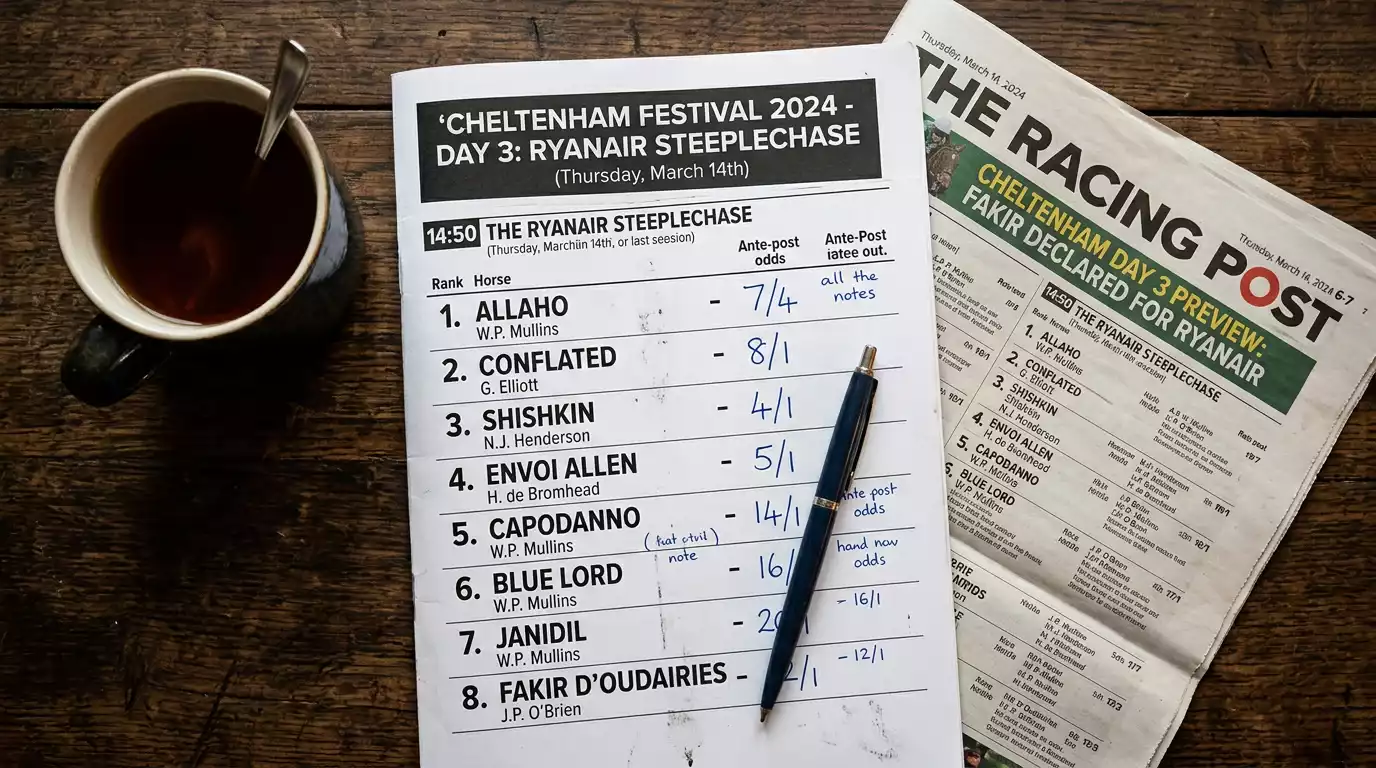
Six weeks before the 2025 Cheltenham Festival, I backed a horse at 20/1 in the ante-post market for the County Hurdle. By the morning of the race, it was 8/1. My place odds, locked in at ante-post, were effectively 5/1 at 1/4 fraction — the day-of-race equivalent was 2/1. The horse placed third. The return from the ante-post price was more than double what I would have received betting on the morning of the race. That is the appeal of ante-post place betting: the odds are longer, the value is greater, and the early mover advantage is real.
The cost is equally real. If that horse had not run — injury, unsuitable ground, trainer’s change of plan — my stake was gone. No refund, no void, no second chance. Ante-post means “before the post,” and the foundational rule is that non-runners lose. Your bet stands regardless of whether the horse makes it to the start. That trade-off — better odds in exchange for non-runner risk — defines ante-post place betting and separates it from every other form of place bet.
See also: place bet horse racing for early-price and ante-post strategies.
How Ante-Post Place Bets Work
An ante-post bet is any bet placed before the final declarations stage for a race. On the Flat, final declarations are typically 24-48 hours before the race. For National Hunt, the window is similar. Any bet placed before that deadline is classified as ante-post and subject to ante-post terms.
The key differences from day-of-race betting are straightforward. First, if your horse does not run, the bet is a loser — no void, no refund. Second, Best Odds Guaranteed does not apply — you receive the price you took, regardless of what the SP turns out to be. Third, Rule 4 deductions do not apply, because the bet was struck before the market that Rule 4 adjusts was formed. Fourth, the place terms are usually those that will apply on the day based on the expected field size, but if the field size changes (runners drop out between declaration and the off), the terms applied at settlement may differ from those you anticipated when placing the bet.
Most major bookmakers offer ante-post place betting on the feature races: Cheltenham, the Grand National, Royal Ascot, the Ebor, the big Saturday handicaps. The ante-post market is deepest on the races that attract the most public interest, because bookmakers price those races early to capture early engagement. Smaller races, midweek handicaps and conditions events rarely have an ante-post place market at all.
Non-Runner Risk: The Price of Early Value
The non-runner risk is not theoretical — it is the central risk of ante-post betting, and it is higher than most punters appreciate. I reviewed my own ante-post betting records from 2020 to 2025 and found that 18% of my ante-post selections did not run. That is nearly one in five bets lost before the race even started, every penny of stake forfeited.
The risk varies by race type and season. Flat handicaps in summer on good ground have lower non-runner rates because the going is predictable and horses are generally healthy. National Hunt races in winter, where the ground can change dramatically in the week before the race and where the physical toll of jumping creates more last-minute injuries, have higher non-runner rates. The Grand National ante-post market is particularly exposed — horses can be eliminated by the BHA Ratings Committee, fail to meet the weights at the five-day stage, or be pulled out by trainers who decide the ground is unsuitable.
The Cheltenham Festival sits somewhere in the middle. Trainers typically target specific races months in advance, which means the intended runners are well-flagged, but the final week before the Festival sees a flurry of withdrawals based on ground conditions, work reports and tactical switches between races. I have learned to factor a non-runner probability into every ante-post place bet: if a horse has a 20% chance of not running, the effective odds need to be 20% longer than fair value just to break even on the non-runner risk alone. That means an ante-post price needs to offer significantly more value than the equivalent day-of-race price to justify the additional risk.
Finding the Value Window: When to Strike
Not all ante-post timing is equal. The odds available six months before a race are longer than those available six days before, but the non-runner risk is also much higher. The optimal window depends on the balance between the two.
For the Cheltenham Festival, I have found the sweet spot to be the two-to-four-week window before the meeting. By that point, the entries have been published, the likely target race for each horse is known, and the odds still reflect meaningful uncertainty about the outcome. Six months before, the odds are longer but the probability that a horse runs in the expected race is substantially lower. Six days before, the odds have compressed and most of the ante-post value has evaporated. The intermediate window captures the best risk-adjusted return.
For the Grand National, the optimal window is tighter: the week after the weights are published (typically in mid-February) through to the five-day stage. During this period, the runners are largely known, the weights create a new information layer that the market prices in gradually, and the odds on place bets still reflect ante-post generosity. After the five-day declarations, the market moves toward day-of-race pricing and the ante-post advantage shrinks.
For summer Flat handicaps, ante-post markets do not typically open until a few weeks before the race, and the value window is correspondingly narrow. I rarely bet ante-post on Flat handicaps unless the price differential is dramatic — 50% or more above what I expect the day-of-race price to be — because the non-runner risk on the Flat, while lower than jumps, is still real and the ante-post market for Flat racing is thinner and less competitively priced. Average Flat field sizes of 8.90 mean that most Flat handicaps offer three paid places, and the ante-post value needs to overcome both the non-runner risk and the narrower place frame. Understanding how non-runners interact with bet settlement in the day-of-race market — where you do get refunds — is covered in the non-runner rules guide.
See also: the Festival is the ultimate ante-post event — read our Cheltenham Festival place bet guide.
FAQ
Do ante-post place bets qualify for extra place promotions?
Generally no. Extra place promotions are applied to bets placed on the day of the race or close to it, not to ante-post bets. The enhanced terms are a promotional feature with specific qualifying conditions, and ante-post bets are almost always excluded. If a bookmaker is offering five places on a race, your ante-post bet will typically settle at the standard three or four places rather than the enhanced terms. Always check the operator’s promotional conditions.
Can I cash out an ante-post place bet before race day?
Some bookmakers offer cash-out facilities on ante-post bets, but the availability varies by operator and by market. Where cash-out is offered, it reflects the current market price and the remaining time to the race. If your selection has shortened significantly since you placed the bet, the cash-out value may represent a guaranteed profit before the race takes place. If the horse has drifted, the cash-out value will be less than your stake. Not all ante-post markets support cash-out.
Prepared by the Place bet Horse Racing editorial staff.