A Dead Heat Cuts Your Place Payout — But Not Always in Half
 Available in US
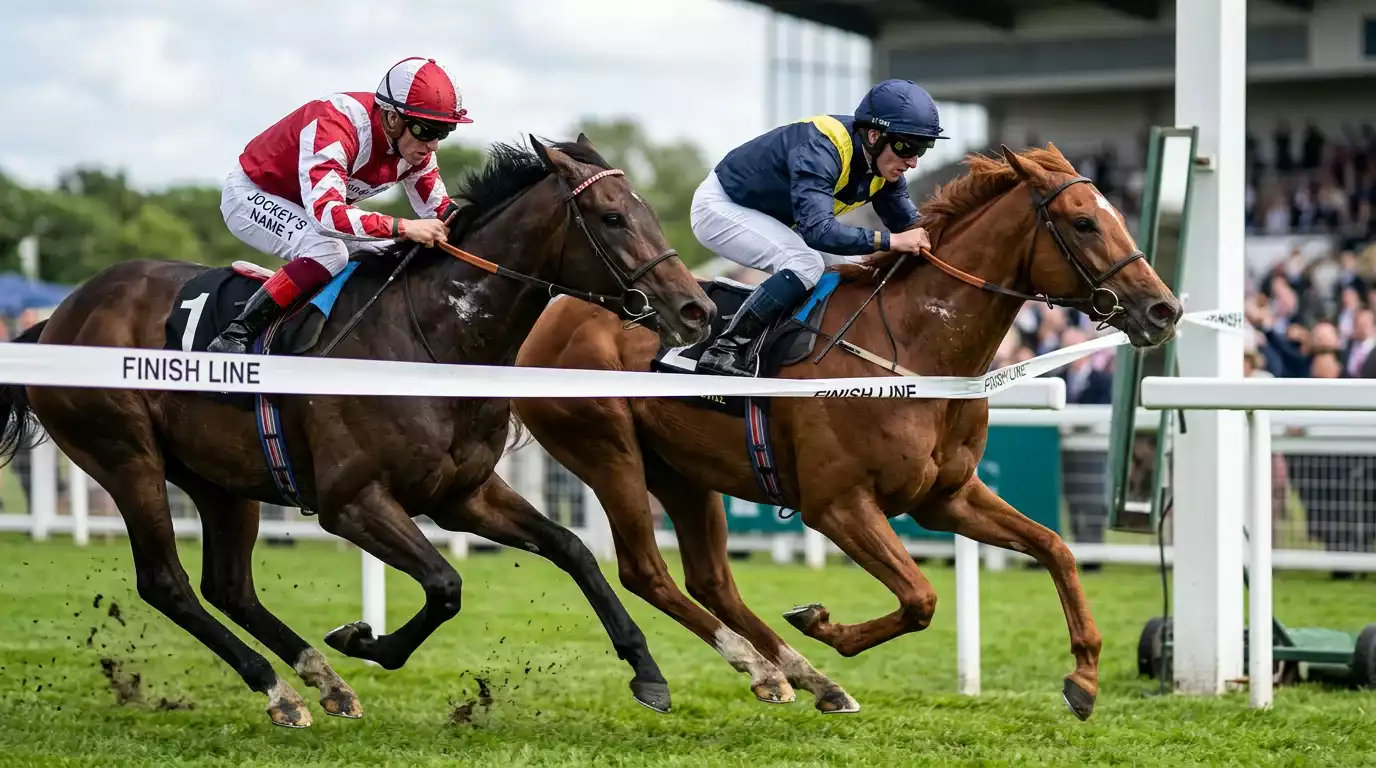
I was at Kempton on a drizzly Wednesday afternoon when the judge called a dead heat for second in a handicap hurdle. My horse was one of the two sharing the position. I expected half my payout. What I actually received was slightly different — and the difference taught me that most punters, and even some tipsters, do not fully understand how dead heat rules interact with place betting. The reduction is mechanical and predictable once you know the formula, but the formula itself has nuances that go beyond “divide by two.”
Dead heats in UK racing are rare enough that you might go an entire season without encountering one. But when they happen, they almost always involve the last qualifying place position — the borderline between collecting and losing. That makes them disproportionately important for place bettors, who by definition are operating at the margins of the finishing order. If you bet on horses to place, dead heat rules are not an obscure technicality. They are a scenario you need to understand before it hits your account balance.
Two-Way Dead Heat: The Standard Halving Rule
Let me walk through the most common scenario because it accounts for the vast majority of dead heats in practice. Two horses are inseparable on the photo finish for the same finishing position. The judge declares a dead heat.
The rule: your stake is divided by the number of horses involved in the dead heat. For a two-way dead heat, your stake is halved. The place odds are then applied to the half-stake, and the other half is treated as a losing bet.
Concrete example. You have placed a 20 pound bet at 10/1 to win, and the race has three paid places at 1/4 odds. Your horse dead-heats for third. Place odds: 10/1 x 1/4 = 5/2. Effective stake after dead heat: 20 / 2 = 10 pounds. Return on the winning half: 10 x 3.5 (decimal equivalent of 5/2, including the stake) = 35 pounds. The other 10 pounds of your original stake is lost. Net result: 35 – 20 = 15 pounds profit.
Without the dead heat, the full payout would have been 20 x 3.5 = 70 pounds, giving you 50 pounds profit. The dead heat cost you 35 pounds in potential returns. Not trivial, but still a profitable outcome. The key psychological adjustment is recognising that a dead heat for a qualifying place is a partial win, not a loss. I have seen punters react to dead-heat settlements as though they have been cheated. They have not. They have had half a winning bet and half a losing one, processed simultaneously.
Three-Way and Multi-Way Dead Heats: Dividing Further
Three-way dead heats are genuinely unusual. I have encountered exactly two in nine years of focused place market analysis. But the rules extend logically from the two-way case and are worth knowing because when they do occur, the payout reduction is dramatic.
For a three-way dead heat, your stake is divided by three. Same mechanics: the winning portion (one-third of your stake) is settled at full place odds, and the remaining two-thirds are treated as losing. Using the same numbers as above: a 20 pound bet at 5/2 place odds in a three-way dead heat returns (20/3) x 3.5 = 23.33 pounds. Net result: 23.33 – 20 = 3.33 pounds profit. Barely positive, but still in the black.
Four-way dead heats are effectively theoretical — I have never seen one in UK racing, and the statistical likelihood of four horses being genuinely inseparable on a photo finish is vanishingly small. But if it happened, the same principle applies: stake divided by four, odds applied to one-quarter.
The pattern is clear: each additional horse in the dead heat reduces your payout dramatically. A two-way dead heat halves your winnings. A three-way dead heat cuts them to a third. The relationship between the dead heat size and your return is linear in the stake division but the perceived impact is non-linear — most punters can absorb a halved payout philosophically, but receiving barely more than their stake back from a three-way dead heat feels disproportionately disappointing. Knowing the maths in advance takes the emotional sting out of it.
Dead Heat for the Last Qualifying Place: The Edge Case
This is the scenario that matters most for place bettors, and it is the one where the interaction between dead heats and place terms creates genuine complexity.
Suppose a race has three paid places. Your horse dead-heats for third — the last qualifying position. Two horses share third place. Under the dead heat rule, your stake is halved and you collect on the half-stake at full place odds. The other horse in the dead heat is treated identically. Both punters receive a reduced payout, and the bookmaker’s liability is roughly equivalent to paying out on one full place bet instead of two.
Now consider a subtly different scenario: your horse dead-heats for second in the same three-place race. Both horses share second. In this case, there is no dead heat reduction for place bets because both horses have finished in a qualifying position — they are both within the top three. The dead heat rule only applies when the tied position is the last one covered by the place terms. If both horses are clearly within the places regardless of how the dead heat is resolved, your bet is settled at full stake.
The distinction is crucial. A dead heat for first in an 8-runner race with three places? No reduction on your place bet — your horse is in the top three either way. A dead heat for second in the same race? Same logic — both second-place horses qualify for a place, no reduction. A dead heat for third? Now the dead heat matters, because if the tie were broken, one horse would be third (qualifies) and the other would be fourth (does not). The dead heat rule splits the difference.
Where this gets particularly interesting is in races with four paid places — the 16+ runner handicaps. In those races, a dead heat for fourth triggers the reduction, but a dead heat for third does not. The more paid places a race offers, the further down the finishing order the “danger zone” for dead heat reductions shifts. This is another structural reason why large-field handicaps with four places are attractive to place bettors: the dead heat risk is pushed to a less likely finishing position. Favourites, who place with a strike rate above 80% in small fields but around 33% in large ones, rarely finish in a dead heat for the last qualifying spot. The dead heat risk sits disproportionately with mid-field runners, which is where place betting value tends to concentrate anyway.
For a broader look at how dead heats interact with the full odds calculation process, the place bet odds guide covers the mathematical relationship in detail.
FAQ
Is a dead heat for second treated differently from a dead heat for first?
For place bet purposes, a dead heat for first or second in a race with three or more paid places results in no reduction to your payout — both horses are within the qualifying positions regardless. The dead heat reduction only applies when the tied position is the last one covered by the place terms. In a three-place race, only a dead heat for third triggers a stake division.
How does a three-way dead heat affect place bet settlement?
Your stake is divided by three. One-third is settled at full place odds, and the remaining two-thirds are treated as a losing bet. For example, a 30 pound place bet at 5/2 in a three-way dead heat returns (10 x 3.5) = 35 pounds, giving you 5 pounds profit on your original 30 pound outlay.
Published by the Place bet Horse Racing team.