The Temptation of Odds-On Place Bets — and Why the Numbers Often Disagree
 Available in US
Early in my career I went through a phase of backing odds-on favourites to place. The logic felt watertight: short-priced horses place more often than they lose, so a steady stream of small returns should build a reliable profit. After six months and 200 bets, I reviewed the spreadsheet and discovered I had made precisely zero profit. The strike rate was 71%. The problem was that every winning bet returned so little that two or three failures wiped out weeks of gains. The numbers were not wrong — I was asking the wrong question.
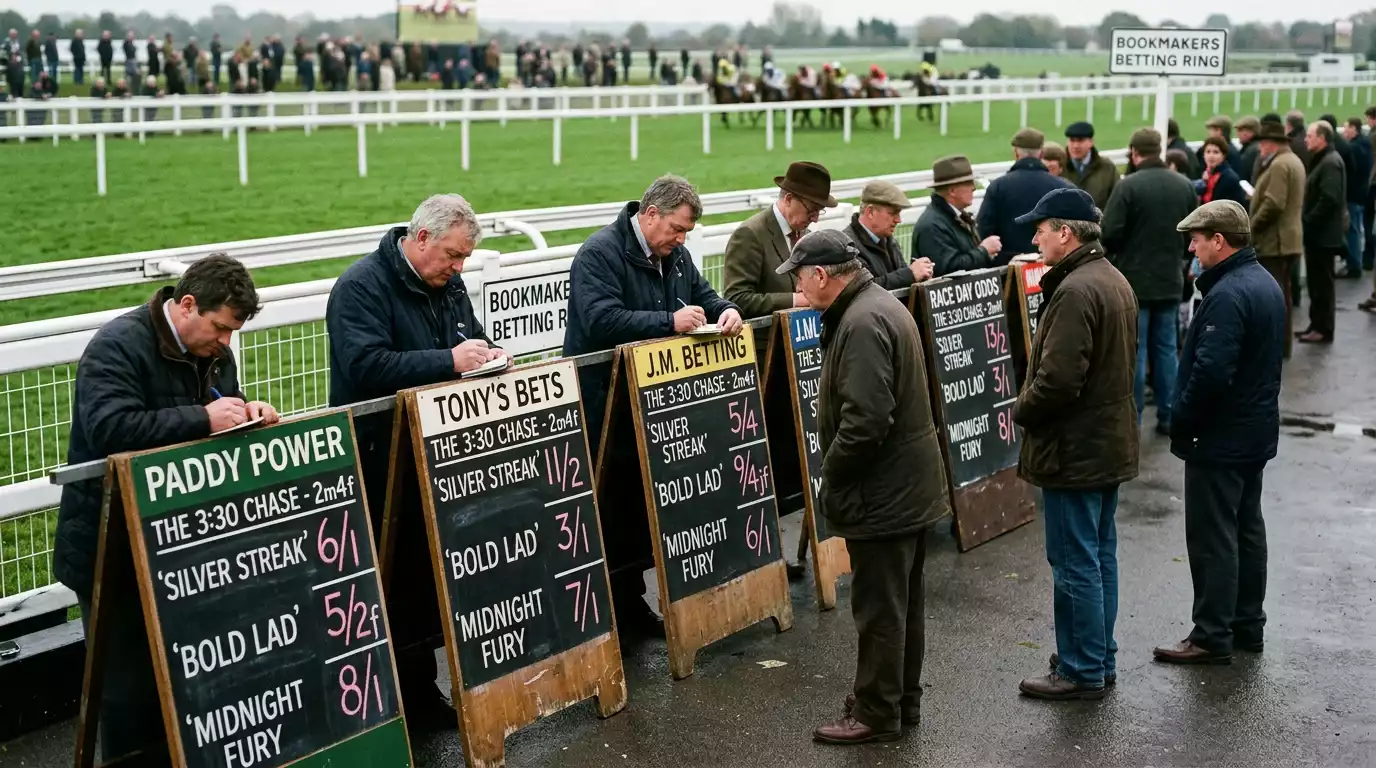
Backing a short-priced favourite to place is one of the most common beginner strategies in UK horse racing, and one of the least examined. Favourites win roughly 33% of large-field races, but their place strike rate can exceed 80% in smaller fields. That headline figure makes place betting on favourites look like found money. The real picture — when you factor in the odds, the fraction, and the inevitable losses — is considerably more nuanced.
See also: place bet horse racing for favourite and outsider strategies.
Favourite Place Strike Rates by Odds Band: What the Data Shows
I pulled together a dataset covering three full UK Flat seasons and segmented favourite place strike rates by their starting price band. The patterns are consistent enough to be useful as planning numbers, even though individual races vary.
Odds-on favourites (below evens) place at approximately 80-85% in races with three paid places. The place odds at 1/4 fraction on a 4/5 favourite are 1/5 — a return of just 1.20 for every pound staked. You need a strike rate above 83.3% to break even at those odds. The actual strike rate hovers right around that line, meaning the bet is roughly neutral before accounting for any edge in your selection process. After nine years of data, I can tell you that the bookmaker’s margin on odds-on favourites in the place frame is razor-thin — they are priced almost exactly at fair value.
Favourites in the 2/1 to 4/1 range place at approximately 60-70%. Place odds at 1/4 fraction on a 3/1 shot are 3/4 — a return of 1.75 per unit. Breakeven strike rate: 57.1%. Here the gap between actual strike rate and breakeven is wider, which means there is genuine room for value if you can identify which 3/1 favourites are more likely to place than others. Going is the biggest differentiator in this band: favourites place at around 50% or above on good going versus roughly 20% on heavy, and that 30-point swing is the single largest variable I have found in any place betting dataset.
Favourites at 5/1 and above place at approximately 45-55%. The place odds are longer (5/4 at 1/4 fraction for a 5/1 shot), the breakeven strike rate drops to 44.4%, and the margin for error widens. This is where place betting on market leaders starts to resemble a genuinely profitable strategy rather than a breakeven grind. The challenge is that horses priced at 5/1 or longer as favourites tend to be in competitive, open races where form is less reliable — precisely the races where the favourite is favourite by a narrow margin rather than a decisive one.
Breakeven Odds: The Minimum Strike Rate a Place Bet on a Favourite Needs
Every place bet has a breakeven point — the strike rate at which you neither make nor lose money over time. Knowing this number before you bet is the difference between strategy and guesswork.
The formula is simple: breakeven strike rate = 1 / decimal place odds. For a horse with decimal place odds of 1.50 (equivalent to 1/2 fractional), you need a strike rate above 66.7%. For odds of 1.25 (1/4 fractional), you need above 80%. For odds of 2.00 (evens), you need above 50%.
I use this as my first-pass filter on any favourite place bet. If the implied breakeven strike rate is 80% or higher, I need to be extremely confident in the horse’s ability to place in that specific race, on that specific going, against that specific field. If the breakeven is 55-65%, the bar is lower and there is more room for the standard variance of racing to work in my favour.
What this means in practice: backing an 8/13 favourite to place at 1/4 fraction gives you place odds of roughly 1.15. Breakeven: 87%. That is a bet where you need your horse to place almost nine times in ten just to stay level. One failure in ten wipes out two or three wins. The asymmetry is punishing. Compare that to a 7/2 favourite to place at 1/4 fraction: place odds of roughly 1.875. Breakeven: 53.3%. Now you only need to be right slightly more than half the time to profit. The difference in the margin for error between those two scenarios is enormous, and it is the reason I avoid odds-on place bets as a regular strategy.
Scenarios Where Backing a Short-Priced Favourite to Place Is Justified
Having argued against the strategy in general, I should acknowledge the specific circumstances where it does make sense. There are three, and I use all of them selectively.
First, as a banker leg in an accumulator. A short-priced favourite with an 80%+ place strike rate serves well as a low-risk leg that keeps the accumulator alive without contributing much to the combined odds. The leg exists to survive, not to generate return. In this context, the poor standalone value is irrelevant — you are buying reliability.
Second, in small fields on good going where the favourite has dominant form. A 4/6 shot in a five-runner novice hurdle on good ground, trained by a top yard, having won its last three starts — that horse has a place probability north of 90%. The place return is minimal, but the probability of loss is genuinely low. I use these bets occasionally as part of a session’s bankroll management: lock in a small return early in the day to offset a later speculative bet that might not land.
Third, when the favourite’s place price on the exchange significantly exceeds the bookmaker equivalent. Exchange place markets are priced independently of the win odds, and I have found situations where the exchange place price on a short-priced favourite is 15-20% longer than the fixed-odds equivalent. At those prices, the breakeven strike rate drops below the horse’s actual expected place rate, creating genuine value even on a short-priced horse. These situations are not common, but they appear frequently enough at the major meetings to be worth monitoring. The broader framework for identifying and exploiting these kinds of edges is developed fully in the data-driven place bet strategy guide.
See also: learn how disputes are handled in our Tattersalls Rule 3 and place terms guide.
FAQ
What place odds can I expect on a 1/3 favourite?
At a 1/4 place fraction, a 1/3 favourite has place odds of 1/12 — a return of just 1.083 for every pound staked, meaning an 8p profit per pound. At 1/5 fraction the return drops further to 1/15. These extremely short odds require a place strike rate above 92% to break even, which even the strongest favourites rarely sustain across a meaningful sample. The returns are so slim that a single failure erases many winning bets.
Is a place single or a place acca better for backing favourites?
For standalone profit, singles are more reliable because each bet settles independently — a loss on one does not destroy the return from another. Accumulators amplify returns when all legs win but produce a total loss when any leg fails. Short-priced favourite place bets work best as banker legs in accumulators, where their high strike rate protects the chain rather than generating the return. The value-generating legs should come from longer-priced selections.
Written by the editors at Place bet Horse Racing.