The Tote Place Pool Pays What the Market Decides, Not the Bookmaker
 Available in US
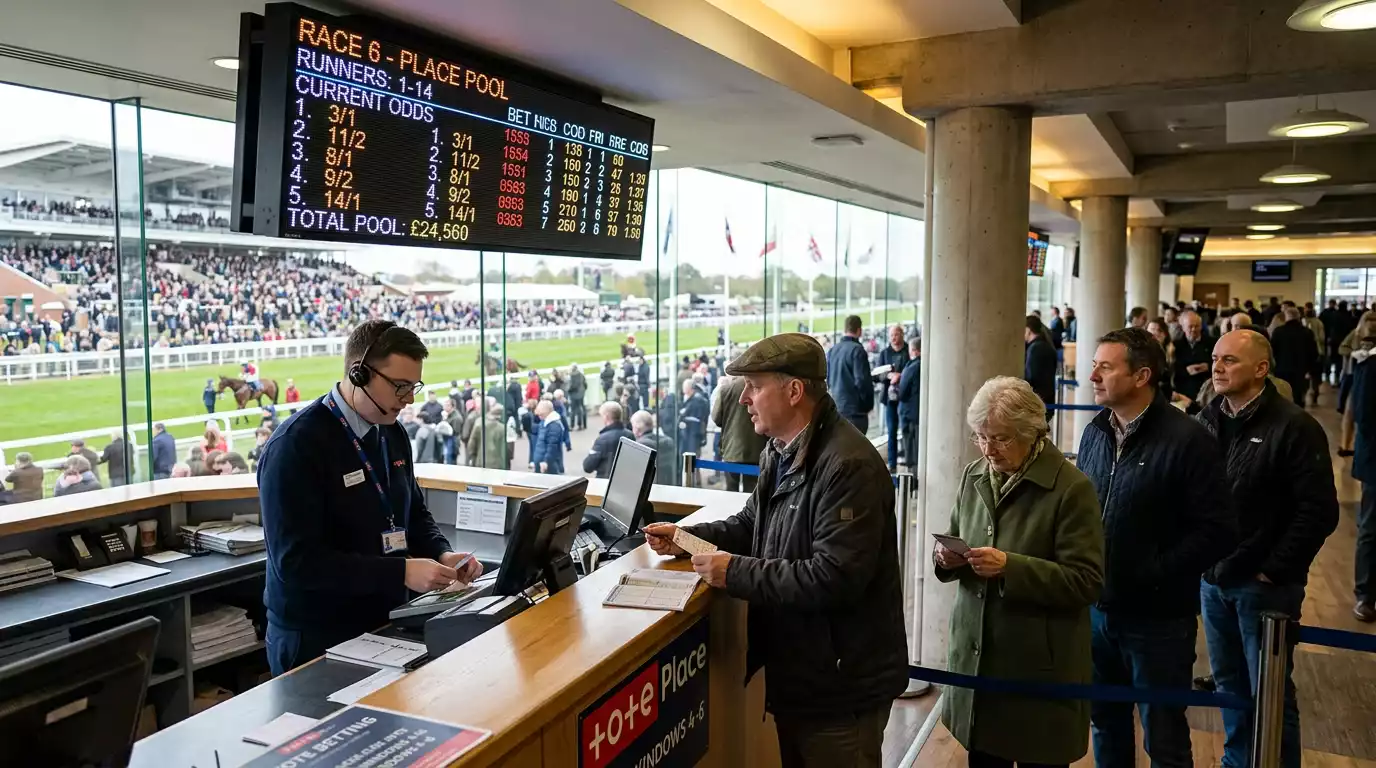
I queued up at a Britbet window during the 2023 Cheltenham Festival and placed a fiver on a 20/1 shot in the place pool. The horse finished third, and the place dividend came back at 4.80 to a 1 pound unit stake. My five pounds returned 24 pounds. Had I taken the same bet with a fixed-odds bookmaker at 1/4 the win odds, my place return would have been 5/1 plus stake = 30 pounds. The pool paid less that time. But I have had it go the other way too — a lightly backed horse in a competitive handicap where the pool dividend exceeded the fixed-odds equivalent by 40%. That is the fundamental proposition of Tote place pool betting: you trade the certainty of known odds for the possibility that the market delivers something better.
Remote betting on UK horse racing generates 766.7 million pounds in gross gambling yield annually, the second-largest sport behind football. The overwhelming majority of that figure flows through fixed-odds bookmakers. The Tote pool sits alongside that market as an alternative mechanism with different economics, different risks, and — in specific scenarios — different returns. Understanding when those returns favour the pool over the bookmaker is the entire game.
See also: place bet horse racing for pool and fixed-odds place betting.
How the Place Pool Collects and Distributes Money
The mechanics are straightforward once you strip away the jargon. Every pound bet into the place pool goes into a common pot. After the race, the Tote deducts its commission (the “takeout”) from the total pool. The remaining money is divided among all winning tickets — that is, all bets on horses that finished in a qualifying place position.
The place pool operates independently from the win pool. You can bet into the place pool without having a win bet, and the dividends are calculated separately. The number of places paid in the pool mirrors the standard Tattersalls framework: two places for 5-7 runners, three for 8-15, four for handicaps with 16 or more.
The takeout rate is the critical variable. Britbet, which operates pool betting on course at most UK racecourses, and the Tote (owned by Betfred) take a percentage before distribution. The exact rate varies but typically runs between 15% and 26% depending on the pool type. For the place pool specifically, the takeout tends to be toward the higher end of that range, which means the pool needs to deliver a meaningfully different distribution of money to beat fixed-odds returns.
Here is what that means in practice: the pool dividend depends entirely on how other bettors have wagered. If the crowd piles money onto the favourite in the place pool, the dividend on the favourite will be low — often worse than fixed odds. But if your horse attracted relatively little pool money and still places, the dividend can be significantly higher than the bookmaker price. The pool is a market. Your return is a function of supply and demand among all participants, minus the house cut.
Fixed-Odds Place Bets vs Pool Dividends: A Side-by-Side Look
Nigel Roddis, Managing Director of Britbet, described the 2025 Cheltenham as a week where the on-course team processed over 570,000 individual bets across four days. That volume tells you the pool has meaningful liquidity at the biggest meetings. At smaller weekday fixtures, the pool can be thin enough that a single sizeable bet moves the dividend noticeably — which is both a risk and an opportunity.
Fixed-odds place bets give you certainty: you know the price at the point of staking. If your bookmaker offers 10/1 on a horse to win and the place fraction is 1/4, your place odds are 5/2, full stop. The price does not move after you bet (assuming you take early price or the SP is in your favour with Best Odds Guaranteed). That certainty has genuine value, particularly for punters who make decisions based on specific return thresholds.
Pool dividends offer no such certainty. You bet into the pool and discover what the dividend is after the race. The dividend is published as a return to a unit stake — “place dividend: 3.40” means you receive 3.40 pounds for every 1 pound staked, including your original stake. Your profit per unit is 2.40 in that case. Whether 2.40 is better or worse than the fixed-odds equivalent depends entirely on the race, the field, and the betting patterns of the crowd.
The structural advantage of the pool shows up most clearly in two scenarios. First, when a well-fancied horse that attracted heavy place pool money fails to place. All the money bet on that horse is redistributed to the qualifying place finishers, inflating their dividends. Second, in large fields where an unfancied horse places. The less money in the pool on your horse, the larger your share of the pot. Both scenarios involve an element that fixed odds cannot replicate: the collective behaviour of other bettors directly increasing your return.
The structural disadvantage is the takeout. The pool operator’s commission is effectively a built-in margin that does not exist in the same form with fixed-odds bookmakers (where the margin is embedded in the odds themselves). For frequently backing horses, the cumulative impact of pool takeout versus bookmaker margin varies, but my analysis over several years suggests that the pool underperforms fixed odds on average, with occasional significant outperformance on specific races.
Scenarios Where Tote Place Pool Offers Better Returns
After tracking pool dividends against fixed-odds place returns across 200+ races over three seasons, I have identified three reliable patterns where the pool tends to outperform.
First, large-field handicaps with a strong beaten favourite. UK racecourse attendance exceeded 5 million in 2025, and at the bigger meetings, the on-course pool attracts serious volume. When that volume concentrates on a favourite that fails to place, the redistribution effect is strongest. I have seen place dividends on 14/1 shots in 20-runner handicaps pay 50% more than the fixed-odds equivalent in these situations.
Second, races where on-course sentiment diverges from the fixed-odds market. The pool reflects the bets of people physically at the track, who sometimes back different horses than the online market suggests. At smaller meetings where the on-course crowd has local knowledge — a trainer’s stable star that the national press has not picked up on — the place pool can undervalue a horse that the crowd knows about and overvalue everything else.
Third, early-card races at midweek meetings where pool liquidity is low. A thin pool means a small number of bets on the placing horses produces a large dividend per unit. The risk is symmetrical — a thin pool also means a single large bet against you can depress the dividend — but if you are betting modest stakes on overlooked horses at quiet meetings, the place pool occasionally delivers returns that the fixed-odds market cannot match.
The comparison between pool and fixed-odds place betting shares DNA with the broader question of each-way versus place-only betting — both involve trade-offs between certainty and potential upside, and both reward the bettor who understands the specific conditions where each option delivers better value.
See also: big fields offer the best Tote value — read our place bet in 16+ runner races guide.
FAQ
Can I place a Tote pool bet online or only at the racecourse?
You can place Tote pool bets both online and at the racecourse. The Tote operates an online platform through Betfred, and Britbet manages on-course pool betting at most UK tracks. Several other licensed bookmakers also offer access to Tote pool products through their websites and apps. The odds displayed are indicative until the pool closes, so the final dividend may differ from the estimate shown when you placed the bet.
Are Tote place pool dividends subject to tax in the UK?
No. UK punters do not pay tax on betting winnings, whether from fixed-odds bookmakers or pool betting. The tax burden falls on the operator, not the bettor. This has been the case since the abolition of on-course betting duty in 2001. Your Tote place pool dividend is paid in full with no deductions for tax.
Written by the editors at Place bet Horse Racing.