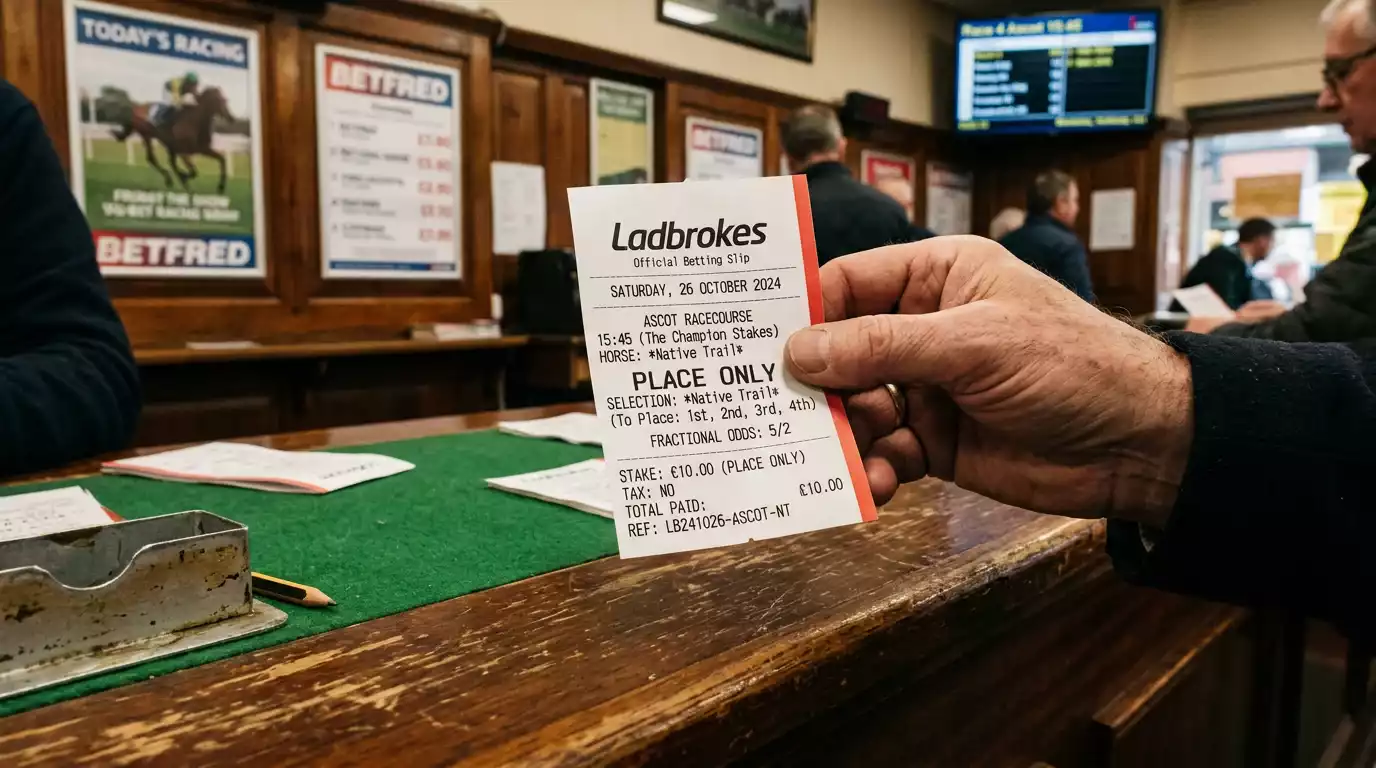
Every Place Bet Payout Follows the Same Three-Step Formula
 Available in US

I spent my first year betting on place markets using gut feeling and rough mental arithmetic. It was only when I sat down and ran the actual numbers on a Saturday afternoon’s results that I realised I had been consistently overestimating my returns. The place fraction — 1/4 or 1/5 of the win odds — makes a bigger dent than most punters intuit, and the only way to get comfortable with it is to learn the formula and practise it until it becomes automatic.
The good news: every place bet payout in UK racing follows the same three-step formula regardless of the race type, the bookmaker, or the odds format. Once you have it, you can calculate any place bet return in your head within a few seconds. With average UK field sizes sitting at 8.90 for Flat and 7.84 for Jumps in 2025, most races you encounter will fall into familiar territory — three places at 1/4 odds for the majority, four places for the larger handicaps. The formula stays the same either way.
See also: place bet horse racing for calculators and payout tools.
The Place Bet Formula: Stake x (Win Odds x Fraction)
Here it is, stripped to its core. Three steps, no exceptions.
Step one: take the win odds in fractional format. If your horse is 10/1 to win, write down 10/1. If it is 7/2, write down 7/2.
Step two: multiply the win odds by the place fraction. For most races, that fraction is 1/4. For some — particularly large-field handicaps where bookmakers offer enhanced terms — it is 1/5. So 10/1 at 1/4 fraction becomes (10 x 1/4) / 1 = 10/4, which simplifies to 5/2. In decimal: 2.5. At 1/5 fraction, 10/1 becomes 10/5 = 2/1 or 2.0 in decimal.
Step three: calculate the return. Multiply your stake by the decimal place odds, then add your stake back. For a 10 pound bet at 5/2 place odds: (10 x 2.5) + 10 = 35 pounds returned. Profit: 25 pounds. That is it. Three steps. Every place bet you will ever calculate follows this pattern.
The formula works identically for decimal odds, which some punters find cleaner. If the win price is 11.0 in decimal (equivalent to 10/1 fractional), convert to the implied fractional first: 11.0 – 1 = 10.0, then apply the fraction. Or take a shortcut: decimal place odds = ((decimal win odds — 1) x fraction) + 1. So ((11.0 – 1) x 0.25) + 1 = 3.5. A 10 pound bet at 3.5 decimal returns 35 pounds. Same answer, different route. For a deeper walk-through of how these fractions interact with the full odds structure, there is a dedicated guide to place bet odds that covers the conversion mechanics in detail.
Worked Example: 1/4 Fraction on a 10/1 Shot
Let me set the scene with a real-world scenario. You are betting on a 12-runner handicap hurdle at Newbury. Your selection is priced at 10/1 to win. The race has more than 8 runners but fewer than 16, so standard terms pay three places at 1/4 of the win odds. You place a 15 pound place-only bet.
Step one: win odds are 10/1.
Step two: place odds are 10/1 x 1/4 = 10/4 = 5/2. In decimal, that is 3.5 (5/2 = 2.5, plus 1 for your stake).
Step three: return = 15 x 3.5 = 52.50 pounds. Profit = 52.50 – 15 = 37.50 pounds.
Now suppose the same horse finishes second. Your payout is identical whether it finishes first, second or third — any qualifying place position pays the same place odds. There is no graduated payout for finishing closer to the winner. Second pays exactly the same as third. This is a point that sometimes confuses punters who are familiar with the US system, where “win,” “place” and “show” are separate pool bets with different returns. In the UK, place is place. One price, any qualifying position.
One nuance worth flagging: if you took this bet at an early price and the horse drifted to 14/1 by the off, your place odds remain locked at the 10/1 price you took — 5/2 for the place. Conversely, if the horse shortened to 6/1, your place bet still settles at 5/2. What you took is what you get, unless your bookmaker offers Best Odds Guaranteed, in which case you receive whichever place price is higher — your early price or the SP-derived place price.
Worked Example: 1/5 Fraction on an 8/1 Shot
Different scenario. You are looking at a 20-runner Flat handicap at York during the Ebor Festival. A bookmaker is offering enhanced terms: four places at 1/5 odds instead of the standard 1/4. Your horse is 8/1 and you stake 20 pounds on a place bet.
Step one: win odds are 8/1.
Step two: place odds are 8/1 x 1/5 = 8/5. In decimal, that is 2.6 (8/5 = 1.6, plus 1 for your stake).
Step three: return = 20 x 2.6 = 52.00 pounds. Profit = 52.00 – 20 = 32.00 pounds.
Compare this to what you would receive under standard 1/4 terms on the same horse. Place odds at 1/4: 8/1 x 1/4 = 8/4 = 2/1. Decimal: 3.0. Return: 20 x 3.0 = 60.00. Profit: 40.00.
The difference is 8 pounds on a 20 pound bet. That is the price of the enhanced promotion — you get an extra paid place (the fourth instead of the third) but each qualifying position pays less. Whether that trade-off is worthwhile depends on where you think your horse will actually finish. If you are confident it will finish in the top three, the 1/4 fraction is better. If you are hedging against a wider range of outcomes, the 1/5 fraction with an extra place provides more coverage at a lower individual payout.
Adjusting the Calculation for a Dead Heat
Dead heats are rare enough that most punters go years without encountering one, but when they happen, the payout adjustment is mechanical and worth knowing in advance rather than scrambling after the fact.
The rule is straightforward: if two horses dead-heat for a qualifying place position, your stake is halved and the place odds are applied to the reduced stake. Three-way dead heats divide your stake by three. The odds themselves do not change — only the stake portion.
Take our first example: 15 pounds on a 10/1 shot at 1/4 fraction, place odds of 5/2. If your horse dead-heats for third (the last qualifying place in a three-place race), your effective stake becomes 15 / 2 = 7.50. Return: 7.50 x 3.5 = 26.25 pounds. Your other 7.50 of stake is treated as a losing bet. So your net position is 26.25 – 15 = 11.25 profit, compared to 37.50 profit without the dead heat. A significant reduction, but still profitable.
The dead heat only affects your payout when it involves the last qualifying place. If your horse dead-heats for first in an 8-runner race with three paid places, both dead-heating horses are first and second — they both qualify, and your place bet is settled at full stake with no reduction. The dead-heat rule only bites when the tie is for the final place position covered by the terms. Understanding this distinction saves unnecessary panic when the judge calls a dead heat.
For a more detailed look at the various dead heat scenarios and how they interact with each-way bets and accumulators, there is a full treatment in the piece on dead heat rules.
See also: prize money affects market depth — read about prize money and place betting.
FAQ
Does a place bet calculator account for Rule 4 deductions?
A basic place bet calculation does not include Rule 4 deductions. Rule 4 is applied separately after the place odds are calculated, reducing your payout by a set percentage based on the price of the withdrawn horse. To get an accurate final figure when Rule 4 applies, calculate your place return first using the standard formula, then subtract the Rule 4 deduction from the winnings portion.
How do I calculate a place bet payout with decimal odds?
Convert decimal win odds to the place equivalent using: decimal place odds = ((decimal win odds — 1) x fraction) + 1. For example, a horse at 9.0 decimal with a 1/4 fraction: ((9.0 – 1) x 0.25) + 1 = 3.0. Multiply your stake by 3.0 to get the total return including your original stake.
Created by the ”Place bet Horse Racing” editorial team.