Exchanges Let You Trade Place Odds — Not Just Bet on Them
 Available in US
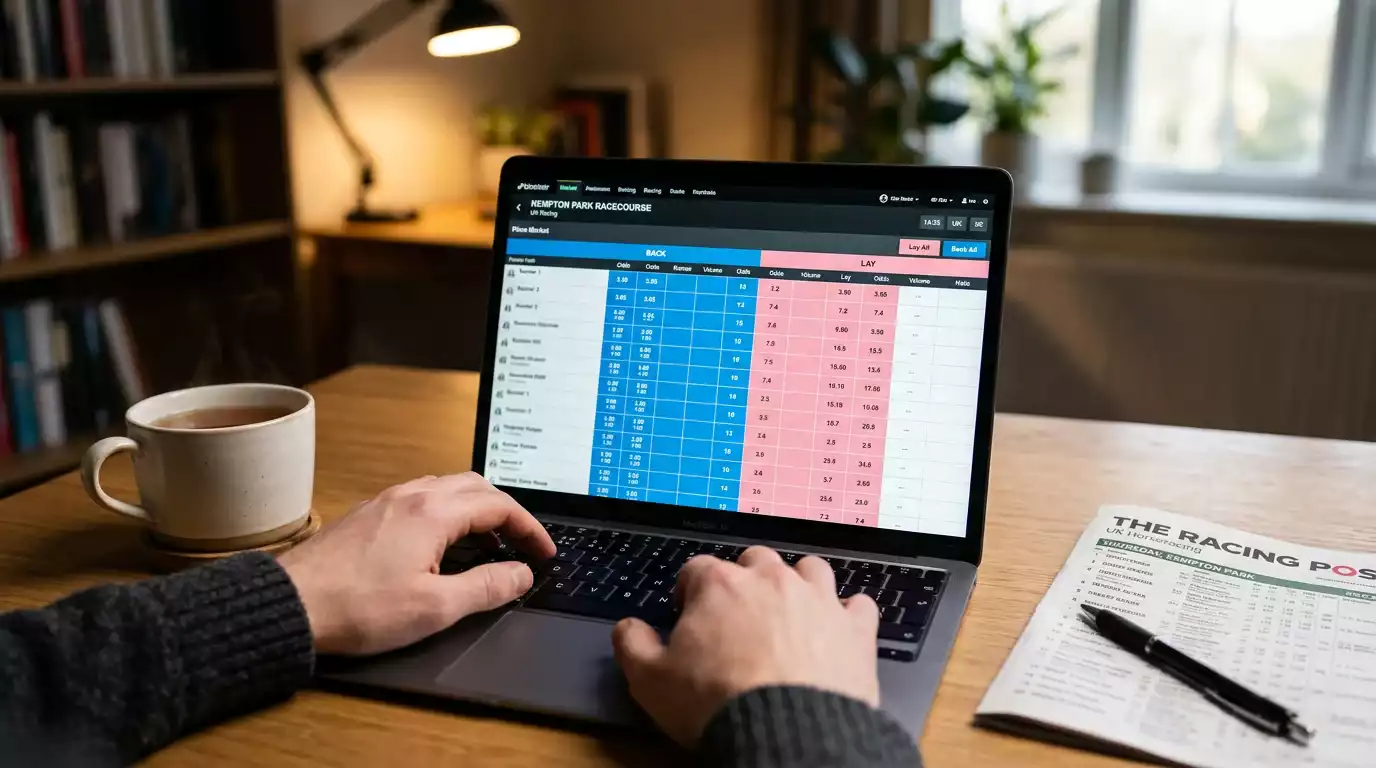
The first time I laid a horse in a place market, I felt like I had found a door in a wall I had been staring at for years. With a traditional bookmaker, you can back a horse to place. On an exchange, you can also lay it — bet against it placing. That asymmetry transforms place betting from a one-directional wager into a two-way market where you can take either side. I have used exchange place markets to hedge positions, to oppose horses I think are overrated in the place frame, and to lock in profit before a race even starts. None of that is possible with a conventional bookmaker.
Remote horse racing betting in the UK generates 766.7 million pounds in gross gambling yield, and while exchanges handle only a fraction of that total, their place markets attract a specific type of bettor — someone who wants price transparency, no bookmaker margin baked into the odds, and the ability to trade positions. If you have only ever used fixed-odds bookmakers for place bets, understanding how the exchange place market works opens up an entirely different dimension of the bet.
See also: place bet horse racing for exchange and bookmaker place markets.
Backing and Laying in the Place Market: How It Works
On an exchange, every bet has two sides. A backer wants the horse to place. A layer wants it not to place. The exchange matches these opposing views and takes a commission from the winner. There is no bookmaker setting the price — the odds are determined entirely by what backers and layers are willing to offer and accept.
The place market on an exchange operates as a separate market from the win market. The number of places paid mirrors the standard terms for the race: two places for 5-7 runners, three for 8+, four for 16+ runner handicaps. You will see separate odds listed for the place market, and these are not derived from the win odds using a fraction. They are independent prices set by market participants. A horse that is 10/1 to win with a bookmaker and 5/2 to place (1/4 fraction) might be trading at 3/1 or 2/1 on the exchange place market, depending on supply and demand.
To back a horse to place on the exchange, you request a price and stake. If a layer is willing to match you at that price, the bet is executed. If nobody matches, the bet sits in the queue until someone does or the market closes. Unmatched bets are cancelled and your stake is returned.
Laying works in reverse. You are offering odds to someone else. If you lay a horse at 3/1 in the place market, you are accepting a potential liability of three times the backer’s stake in exchange for keeping that stake if the horse fails to place. Laying is how exchange users “become the bookmaker” on a specific outcome, and it carries risk proportional to the odds you offer.
Commission Rates and Liquidity: What Place Market Bettors Face
Exchange commission is the price of admission. Every winning bet on the exchange is subject to a commission charge, typically between 2% and 5% of your net winnings depending on the platform and your account status. Losing bets incur no commission — you only pay when you win.
This commission structure is fundamentally different from the bookmaker model, where the margin is embedded in the odds themselves. With a bookmaker, you pay the margin on every bet whether you win or lose, through slightly less generous odds than a “true” market would offer. On an exchange, the displayed odds are closer to the true market probability, but you surrender a portion of your winnings when you collect.
For place bets specifically, the commission impact varies with the odds. At short place prices (say, 1.5 in decimal), a 5% commission on a one-unit win is only 0.025 units — negligible. At longer place odds of 5.0, the commission on a four-unit win is 0.2 units — still modest but it compounds over hundreds of bets. I track my commission outlay as a line item in my betting records, and over a full season it typically runs at 3-4% of gross place market profits. That is lower than the effective margin I pay to most fixed-odds bookmakers on place bets, but the difference is not dramatic.
Liquidity is the bigger constraint. The win market on exchanges is heavily traded for most UK races. The place market is not. On feature races at Cheltenham, Ascot and the other major meetings, place market liquidity is strong enough to match bets of 50 to 500 pounds without moving the price. On a Tuesday afternoon at Plumpton, the place market may have barely a few hundred pounds available across all runners. Thin liquidity means your bet may not be matched, or you may need to accept a worse price to get your stake on. Betting turnover on UK racing has fallen 12.8% over two years through late 2025, and while this affects all markets, exchange place markets — already less liquid than the win market — feel the squeeze more acutely.
Exchange Place Odds vs Fixed-Odds Bookmaker: A Price Comparison
I ran a comparison across 50 handicap races during the 2025 Flat season, matching the best available exchange place odds against the fixed-odds equivalent from three major bookmakers. The results were instructive.
On average, exchange place odds were 8-12% longer than the fixed-odds equivalent. A horse trading at 3.0 on the exchange place market might be offered at 2.7 by a fixed-odds bookmaker (after applying the 1/4 fraction to the win price). That gap — roughly 10% on average — is real money over a sustained betting campaign. On 1,000 pounds of turnover, the exchange returned approximately 80 to 120 pounds more before commission. After commission at 4%, the net advantage was closer to 50 to 80 pounds.
But the exchange advantage was not uniform. On heavily backed favourites, the exchange place price was often worse than the bookmaker price, because exchange layers demanded a premium to take on the risk of short-priced horses placing (which they do the majority of the time). On mid-range and outsider selections, the exchange consistently offered better value. The sweet spot in my data was horses priced between 8/1 and 20/1 to win, where the exchange place market offered materially better odds than any fixed-odds bookmaker.
The other advantage unique to exchanges is the ability to trade out. If you back a horse to place at 4.0 and the price shortens to 2.5 before the race, you can lay the horse at 2.5 to lock in a profit regardless of the result. This is impossible with a traditional bookmaker (unless cash-out is available, which is a different mechanism with different terms). Trading in the place market requires good timing and sufficient liquidity, but when conditions align, it allows you to manage risk in a way that fixed-odds betting simply does not support.
For punters weighing exchange place markets against the more conventional each-way and place-only options with fixed-odds bookmakers, the exchange adds a third dimension worth considering — particularly for those comfortable with the mechanics of backing and laying.
See also: understand the tax position before trading with our gambling tax in horse racing guide.
FAQ
How many places does a betting exchange pay on place markets?
Exchange place markets mirror the standard UK place terms: two places for races with 5 to 7 runners, three places for 8 to 15 runners, and four places for handicaps with 16 or more runners. The exchange does not set its own place terms — it follows the same framework used across the industry, derived from Tattersalls Rule 3.
Is commission charged on losing exchange place bets?
No. Exchange commission is charged only on net winning bets. If your place bet loses, you pay no commission — you simply lose your stake. The commission rate typically ranges from 2% to 5% of net winnings depending on the exchange platform and your account tier. This structure means you only pay for the service when it delivers a return.
Prepared by the Place bet Horse Racing editorial staff.